




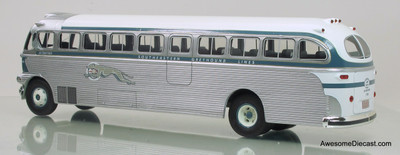
AHM 1:50 1948 ACF Brill IC-41 Intercity Coach: Southeastern Greyhound Line: Atlanta, GA
Resin-cast. Limited edition of 600 pieces Destination: Atlanta Includes Full-Size Replica of a 1949 Southeastern Greyhound Bus Time Tables


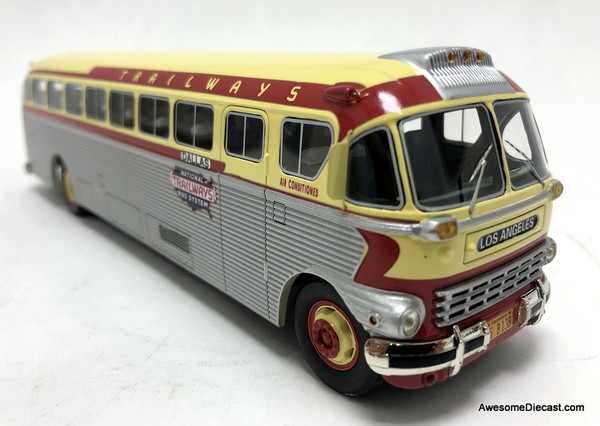


Resin-cast - limited edition
The J.G. Brill Company manufactured streetcars, interurban coaches, motor buses, trolleybuses and railroad cars in the United States for almost ninety years; it was the longest lasting trolley and interurban manufacturer. At its height, Brill was the largest manufacturer of streetcars and interurban cars in the US and produced more streetcars, interurbans and gas-electric cars than any other manufacturer, building more than 45,000 streetcars alone.
The company was founded by John George Brill in 1868 as a horsecar manufacturing firm in Philadelphia. Its manufacturing factory complex was located in Southwest Philadelphia at 62nd St and Woodland Avenue adjacent to the Baltimore and Ohio Railroad tracks. Over the years, it absorbed numerous other manufacturers of trolleys and interurbans such as Kuhlman in Cleveland and Jewett in Indiana. In 1944, with business diminishing, it merged with the American Car and Foundry Company (ACF) to become ACF-Brill. Although the company ceased production in 1954, some of its interurbans served the Philadelphia area until the 1980s.
In 1868, the Brill company was founded as J.G. Brill and Sons. After James Rawle joined the firm in 1872 it was renamed The J.G. Brill Company.
In 1902, Brill bought out the American Car Company; in 1904 G. C. Kuhlman Car Company and John Stephenson Company; and in 1907 Wason Manufacturing Company. Brill acquired a controlling share of the Danville Car Company in 1908, dissolving it in 1911, and Canadian railway car builder Preston Car Company in 1921, which ceased operating in 1923.
As large orders continued to be won by Brill, new facilities including steel forges and cavernous erecting shops continued to be added in Philadelphia. One particularly large order, received in 1911, was for 1,500 streetcars for the Philadelphia Rapid Transit Company. It took two years to build those trolleys with delivery rates at times exceeding a hundred cars a month. All told, more than 30,000 rail vehicles were produced at the Brill plant. In its best years, a workforce of 3,000 Philadelphians was employed by Brill; many of those were skilled laborers and craftsmen.
The last rail cars built by J.G. Brill were 25 streamliners for Atlantic City in 1939, and a final 10 trolleys for Red Arrow Lines two years later. Production shifted to rubber-tired vehicles, with more than 8,000 gasoline- and electric-powered buses (trolley buses) built in the 1940s. But by the early 1950s even the bus orders had dried up. In March 1954, the plant was sold to the Penn Fruit Company and a strip mall was built on the eastern end of the site.
In 1926, American Car and Foundry Company acquired a controlling interest in what had become the Brill Corporation. The new structure consisted of:
ACF Motors Company, which owned Hall-Scott Motor Car Company (100%) and controlled 90% of Fageol Motors; and
the J.G. Brill Company.
In 1944, these two companies merged, forming the ACF-Brill Motors Company.
Resin-cast. Limited edition of 600 pieces Destination: Atlanta Includes Full-Size Replica of a 1949 Southeastern Greyhound Bus Time Tables
Iconic Replicas
Scale: 1:50, ideal for collectors looking for detailed and accurate models. Livery: Trailways, featuring yellow and red colors with pad-printed graphics. Material: All diecast metal construction...

