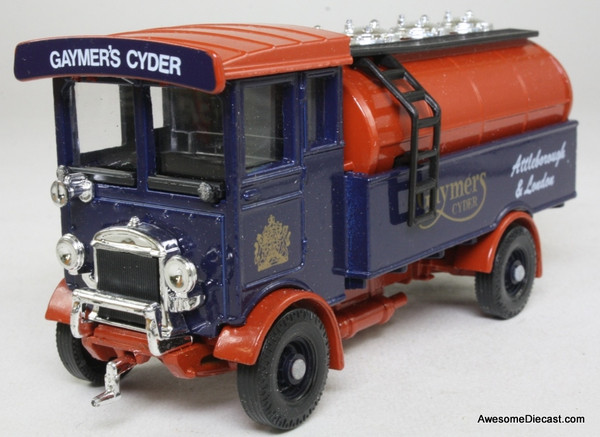
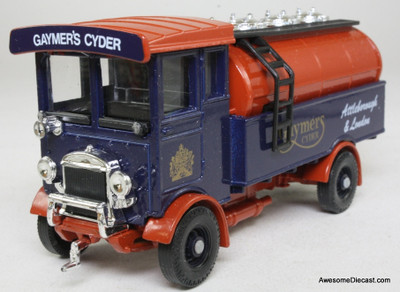
Diecast metal with plastic parts
Associated Equipment Company (AEC) was an English vehicle manufacturer that built buses, motorcoaches and trucks from 1912 until 1979. The name Associated Equipment Company was hardly ever used; instead it traded under the AEC and ACLO brands.
AEC's first commercial vehicle was a lorry based on the X-type bus chassis. With the outbreak of World War I in 1914, AEC's ability to produce large numbers of vehicles using assembly line methods became important in supplying the increasing need for army lorries. AEC began large-scale production of the 3-ton Y-type lorry, commenced in 1916, and continued beyond the end of the war. From then on, AEC became associated with both lorries and buses.
In 1926, AEC and Daimler formed the Associated Daimler Company, which was dissolved two years later. In 1927, AEC moved its manufacturing from Walthamstow to a new plant at Southall.
G. J. Rackham was appointed Chief Engineer and Designer in 1928. He had previously worked for Leyland Motors. His ideas contributed significantly to AEC's reputation for quality and reliability.
From 1929, AEC produced new models: the names of lorries began with "M" (Majestic, Mammoth, Mercury, and so on), and those of buses began with "R" (Regent, Regal, Renown, and so on). These original "M-models" continued in production until the end of World War II. AEC introduced diesel engines across the range in the mid-1930s.
From 1931 to 1938, AEC and English Electric co-produced trolleybuses. AEC supplied the chassis, and English Electric the electric motors and control equipment.
In 1932, AEC took a controlling interest in the British subsidiary of the American Four Wheel Drive (FWD) company, and began to use more standard AEC components in those vehicles. To avoid confusion, these were marketed under the name Hardy. Production ceased about 1936.
It is unknown when the Gaymer family started selling cider. An advertisement in 1875 describes them as being “established upwards of two centuries”, one of 1883 “established nearly two centuries”, a 1961 newspaper report talks of “more than 300 years” and a modern bar towel has the phrase “established 1770” on it. One source[who?] states that in 1784 Robert Gaymer moved with his family from Starston to Banham (both are places in Norfolk), where he farmed “and produced the first identifiable Gaymer cider”. His son John, “Long” John as he was known, due to his height of 6 ft. 10½in., continued the cider-making, and indeed an advertisement from “The Bury and Norwich Post” of 26 May 1800 states that he had inherited the trade secrets of his father-in-law Joseph Chapman which were “the result of the last ten years practice and experience” and that “The cydermaking business is carried on by the said John Gaymer at Banham aforesaid, by whom all orders will be thankfully received, and readily executed”. Joseph Chapman was describing himself as a “cyder merchant” in 1781. “Long” John was buried in Banham churchyard in 1843.
Olde English is a brand of cider (formerly known by the alternative spelling cyder). Unlike most English ciders being grown in the west of the country in counties such as Devon, Herefordshire and Somerset, Gaymer's originated in eastern England.
“Ye Olde English Cyder” was apparently designed for the American market in 1939, but never shipped out due to the outbreak of the Second World War: it was sold in the UK as a special offer during the war and until 1950, and then became a standard product of the company. By the time of the Showerings takeover in 1961 “Olde English” was Gaymer’s best known product.
Today Gaymer's Olde English is mostly sold through supermarkets and off licence chains. In 2007, coinciding with a can redesign, the strength of canned Olde English was reduced from 5.3% ABV to 4.5% ABV.