













Corgi
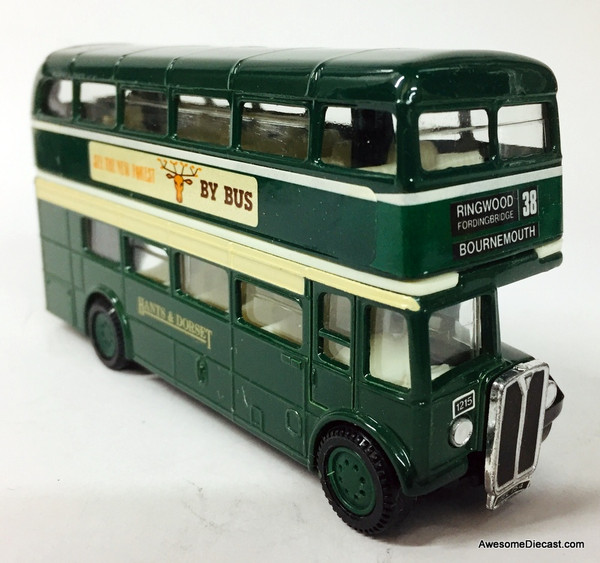
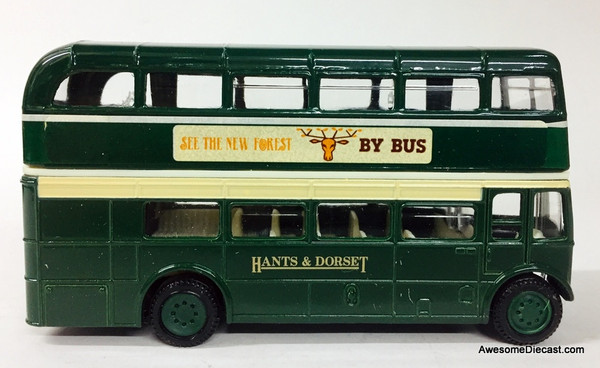
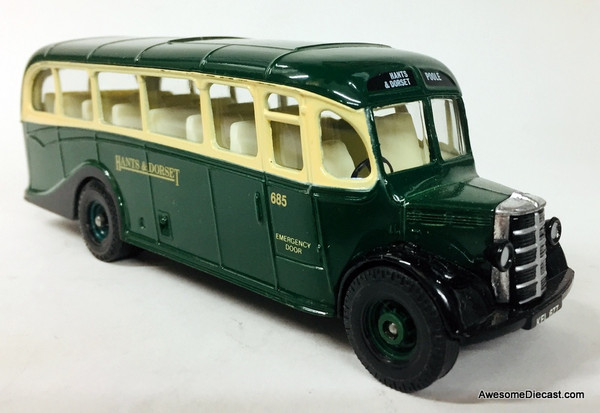
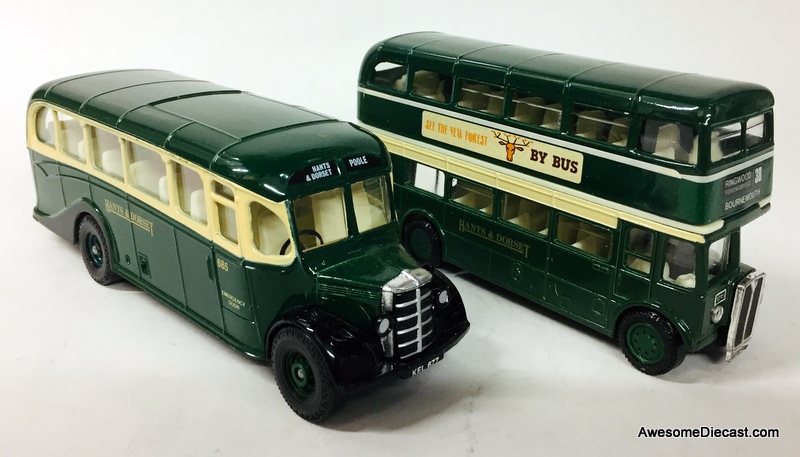
Corgi: Bedford OB Coach & AEC Regent Double Decker Set: Hants & Dorset

Corgi: Bedford OB Coach & AEC Regent Double Decker Set: Hants & Dorset
$49.95
The Bedford OB was a bus chassis manufactured by Bedford from 1939.
The Bedford OB was designed as a successor to the Bedford WTB. It had a wheelbase of 14 feet 6 inches (4.42 m), and was a semi-forward control model, designed to carry 26 to 29-passenger bodywork. It was fitted with a 27.34 horsepower petrol engine, and had a four-speed manual gearbox and fully floating rear axle. The brakes were of the vacuum servo-assisted hydraulic type.
Although only 73 were built prior to the cessation of production due to World War II, it reappeared in a largely unchanged form at the end of the war, continuing in production until 1951. A total of 12,766 were produced, making it one of the most popular buses of its type ever.
Bedford co-developed with Duple the "Vista" coachwork for the OB, fronted by a classic bullnose. The ash framework was reinforced with steel, and the floor made from hardwood with softwood tongued and grooved boarding, with the exception of the cab area which was finished with alloy chequerplate. Seating capacity was normally 29 with overhead luggage racks provided for passengers, whilst the rear luggage boot was also used to store the spare wheel. The price of a complete coach, including finishing in a two-colour livery, was £1,314.10s for a 27-seater, and £1,325.10s for a twenty nine seater.
Geared to reach speeds of at least 40 miles per hour (64 km/h), which was fast for its day, the OB is remembered by many for its characteristic gearbox whine.
The AEC Regent III RT was one of the variants of the AEC Regent III. It was a double-decker bus produced jointly between AEC and London Transport. It was the standard red London bus during the 1950s and continued to outnumber the better known Routemaster throughout the 1960s.
The prototype (London Transport RT 1) was built in 1938 with an AEC 8.8-litre engine (a stopgap measure until the new 9.6-litre was available) and air-operated pre-selective gearbox. Finding a satisfactory British substitute for the German air compressor, bought from Bosch, was to cause problems for AEC, once war broke out. A prototype chassis was placed into service, disguised as an old vehicle. It carried a secondhand open-staircase body previously carried on Leyland Titan (fleet number TD 111), dating from 1931. Thus bodied, RT 1 entered service in July 1938 as ST 1140, even though it was nothing like a standard ST vehicle. It continued in service until December 1938.
While the chassis was on trial, a new body was constructed at London Transport's Chiswick Works. Its four-bay body resembled that of the Roe Leeds City Pullman body exhibited at the 1937 Commercial Motor Show, though the overall impression of modern design and the features included marked a big step forward. This body replaced the old one on RT 1 and the bus re-entered service in 1939.
Hants & Dorset Motor Services was a stage carriage bus service operator in southern England between 1920 and 1983.
In 1916, the British Automobile Traction Company and others formed the Bournemouth & District Motor Services Limited. Following the purchase of Trade Cars of Southampton in 1920, the Hants & Dorset name was adopted. In that same year, the Tilling Group bought an interest in the company and from that year till 1929 Hants & Dorset grow rapidly.
In 1929, the Southern Railway took up its option to buy shares, under the terms of the Road & Rail Transport Act 1928, when the four railway companies were able to invest in bus operators.
By the late 1920s and early 1930s, the network of Hants & Dorset bus services was largely complete. Hants & Dorset operated buses in Bournemouth, Poole, Southampton, Lymington, Fareham and Winchester. Hants & Dorset replaced the trams operated by Poole Corporation in 1934.