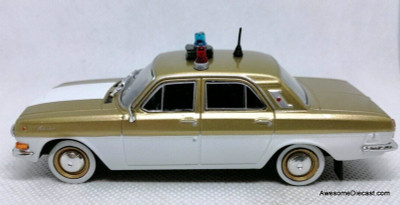
This model comes in a blister pack
The UAZ-452 is a family of off-road vans produced at the Ulyanovsk Automobile Plant (UAZ) since 1965. As of today (2021) these vans and most of their variants are still in production, due to their popularity, reliability, and off-road capability that other competing vans, such as the GAZelle or GAZelle NEXT, don't have. The vehicle was the second light truck developed by the company after the GAZ-MM.
Although GAZ and UAZ were separate companies from 1949 to 1951, they quickly re-merged again in 1953. The vehicle was initially developed as a replacement for the truck-based vans such as the GAZ-51 or GAZ-53 that had enclosed variants, although these variants continued to be produced even after the introduction of the new van.
The model's predecessor, the UAZ-450 (produced between 1958-1966), was based on the chassis and engine of the four-wheel drive light truck GAZ-69, and was the first "forward control" vehicle of this type to be built in the Soviet Union and Russia. The -450 was lightly revised and simplified, resulting in the -452. Because of the external similarities to a loaf of bread, the van became known as Буханка (bukhanka, loaf) in Russian. The ambulance version was nicknamed Таблетка (tabletka, a pill). The van is produced in several modifications, with the main difference being the body type (e.g. UAZ-3741 van (known as bukhanka), or the UAZ-3303 pickup truck, which is known as golovastik, tadpole).
The body of the van is normally equipped with two front doors, a single-wing door on the right side and a double-wing door at the rear, although the exact configuration can vary depending on the specific modification. Notable in the van are the fuel ports on the left and the right side of the van, leading to two separate fuel tanks.
The engine, placed between the driver and the passenger seats, was the same 75 hp (56 kW; 76 PS) 2,445 cc (149.2 cu in) UMZ 452MI inline four as the UAZ-469, and was able to run on gasoline of as low as 72 octane (76 was preferred).