










Gemini 200
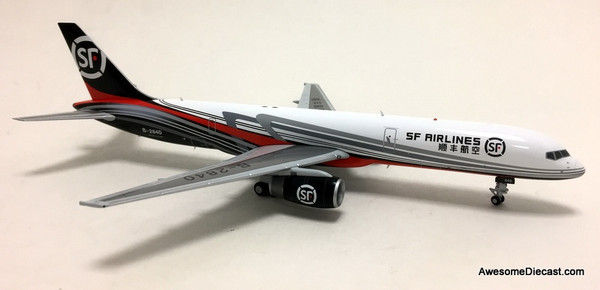
Gemini 200 1:200 Boeing 757-200F: SF Airlines, Cargo Plane

Gemini 200 1:200 Boeing 757-200F: SF Airlines, Cargo Plane
£59.75
The Boeing 757 is an American narrow-body airliner that was designed and built by Boeing Commercial Airplanes. The then-named 7N7, a successor for the 727 (a trijet), received its first orders in August 1978. The prototype completed its maiden flight on February 19, 1982 and it was FAA certified on December 21, 1982. Eastern Air Lines placed the original 757-200 in commercial service on January 1, 1983. A package freighter (PF) variant entered service in September 1987 and a combi model in September 1988. The stretched 757-300 was launched in September 1996 and began service in March 1999. After 1,050 had been built for 54 customers, production ended in October 2004, while Boeing offered the largest 737 NG variants as a successor.
The twinjet is powered by 36,600–43,500 lbf (163–193 kN) Rolls-Royce RB211 or Pratt & Whitney PW2000 underwing turbofan engines for a 255,000–273,000 lb (116–124 t) MTOW. The 757 has a 2,000 sq ft (185 m²) supercritical wing for reduced aerodynamic drag and a conventional tail. It keeps the 707 cross-section and its two-crew glass cockpit has a common type rating with the concurrently designed 767 (a wide-body aircraft). It was produced in two fuselage lengths: the 155 ft (47.3 m) long 757-200 (the most popular with 913 built) typically seats 200 passengers in two classes over 3,915 nmi / 7,250 km; while the 178 ft (54.4 m) long 757-300 typically seats 243 over 3,400 nmi / 6,295 km. The 757-200F can haul a 72,210 lb / 32,755 kg payload over 2,935 nmi / 5,435 km. Passenger 757-200s have been modified for cargo use as the special freighter (SF).
Major customers for the 757 included U.S. mainline carriers, European charter airlines, and cargo companies. It was commonly used for short and mid-range domestic routes, shuttle services, and transcontinental U.S. flights. ETOPS extended flights were approved in 1986 to fly intercontinental routes. Private and government operators have customized the 757 as VIP carriers like the US C-32. In July 2017, 666 were in airline service; Delta Air Lines was the largest operator with 127 aircraft. The airliner has recorded eleven hull-loss accidents, including eight fatal crashes, as of June 2019.
In the early 1970s, following the launch of the wide-body 747, Boeing began considering further developments of its narrow-body 727 trijet. Designed for short and medium length routes, the three-engined 727 was the best-selling commercial jetliner of the 1960s and a mainstay of the U.S. domestic airline market. Studies focused on improving the 189-seat 727-200, the most successful 727 variant. Two approaches were considered: a stretched 727 (to be designated 727-300), and an all-new aircraft code-named 7N7. The former was a cheaper derivative using the 727's existing technology and tail-mounted engine configuration, while the latter was a twin-engine aircraft which made use of new materials and improvements to propulsion technology which had become available in the civil aerospace industry.
The 757 was intended to be more capable and more efficient than the preceding 727. The focus on fuel efficiency reflected airline concerns over operating costs, which had grown amid rising oil prices during the Yom Kippur War of 1973. Design targets included a 20 percent reduction in fuel consumption from new engines, plus 10 percent from aerodynamic improvements, versus preceding aircraft. Lighter materials and new wings were also expected to improve efficiency. The maximum take-off weight (MTOW) was set at 220,000 pounds (99,800 kg), which was 10,000 pounds (4,540 kg) more than the 727. The 757's higher thrust-to-weight ratio allowed it to take off from short runways and serve airports in hot and high conditions with higher ambient temperatures and thinner air, offering better takeoff performance than that offered by competing aircraft. Competitors needed longer takeoff runs for these hot and high conditions. Boeing also offered options for higher payload capability.
SF Airlines is a Chinese cargo airline owned by SF Express (Group) Co. The company is headquartered in the No.1 Freight Depot of the International Shipping Center of Bao'an International Airport in Bao'an District, Shenzhen, Guangdong province
Although a preparatory team for SF Airlines was founded in 2005, it wasn't until 2009 that the preparation was approved by the Civil Aviation Administration of China. A successful maiden flight was made on 31 December 2009.
SF Airlines began its first flights, in 2010, to the plateau area of Yushu City, Qinghai carrying earthquake relief materials. Shortly after, a second Boeing 757-200F was put into operation.
In 2011, SF Airlines became the first company in the industry to pass the CCAR-121-R4 for supplemental operations. They also flew their first Boeing 737-300F in 2011. SF Airlines passed the International Region Supplemental Operation Assessment and became qualified to operate international routes.
In 2012, SF Airlines operated its first Boeing 737-400F.
In October 2014 Boeing announced that an undisclosed number of Boeing 767-300ER will be converted by Boeing to a Freighter as part of the proven BCF Program for Fleet Expansion by SF Airlines with an entry into service in 2015 of the first aircraft. This agreement also included a Letter of Intent to acquire Boeing 737 Next Generation 800 based Boeing Converted Freighters for future fleet expansion and to replace existing B737 Classic aircraft.
SF Airlines had a fleet of 26 Boeing aircraft by the end of 2015. The company managed to establish a hub in Hangzhou Xiaoshan International Airport to help expand its business in East China.
On 21 October 2016, SF Airlines' 36th freighter and also the 4th B767-300BCF took its test flight in Singapore then diverted to Shenzhen Bao'an International Airport and SF Airlines was arguably the No.1 cargo carrier in China in terms of fleet numbers.
In November 2017, SF airlines bought 2 Boeing 747-400ERF of defunct Jade Cargo International, in an auction held by Alibaba worth 320 million CNY (US$48.4 million).