








Gemini 200
McDonnell Douglas DC-3: Pan American Airways (Reg #NC33611) 1:200 Diecast Model Plane by Gemini 200
This model can be displayed on the stand or with the landing gear down



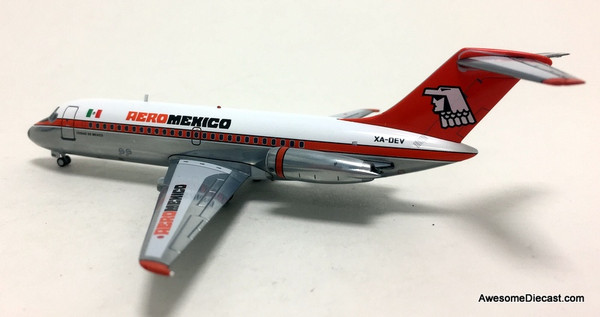


The McDonnell Douglas DC-9 (initially the Douglas DC-9) is a single-aisle airliner designed by the Douglas Aircraft Company. After introducing its heavy DC-8 in 1959, Douglas approved the smaller, all-new DC-9 for shorter flights on April 8, 1963. The DC-9-10 first flew on February 25, 1965 and gained its type certificate on November 23, to enter service with Delta Air Lines on December 8. With five seats across in economy, it had two rear-mounted Pratt & Whitney JT8D turbofans under a T-tail for a cleaner wing, a two-person flight deck and built-in airstairs
The Series 10 are 104 ft (32 m) long for typically 90 coach seats. The Series 30, stretched by 15 ft (4.5 m) to seat 115 in economy, has a larger wing and more powerful engines for a higher MTOW; it first flew in August 1966 and entered service in February 1967. The Series 20 has the Series 10 fuselage, more powerful engines and the -30 improved wings; it first flew in September 1968 and entered service in January 1969. The Series 40 was further lengthened by 6 ft (2 m) for 125 passengers, and the final DC-9-50 series first flew in 1974, stretched again by 8 ft (2.5 m) for 135 passengers. When deliveries ended in October 1982, 976 had been built. Smaller variants competed with the BAC One-Eleven, Fokker F28 and Sud Aviation Caravelle, and larger ones with the original Boeing 737.
The DC-9 was followed by the MD-80 series in 1980, a lengthened DC-9-50 with a larger wing and a higher maximum takeoff weight (MTOW). Itself developed into the MD-90 in the early 1990s, stretched again, with V2500 high-bypass turbofans and an updated flight deck. The shorter, final MD-95 was renamed the Boeing 717 after McDonnell Douglas's merger with Boeing in 1997, powered by Rolls-Royce BR715 engines. China's Comac ARJ21 is built with its tooling and thus shares its fuselage cross-section, nose profile, and tail.
Aerovías de México, S.A. de C.V. operating as Aeroméxico (stylized as AEROMEXICO), is the flag carrier airline of Mexico based in Mexico City. It operates scheduled services to more than 90 destinations in Mexico; North, South and Central America; the Caribbean, Europe and Asia. Its main base and hub is in Mexico City, with secondary hubs in Guadalajara and Monterrey. The headquarters is in the financial district on Paseo de la Reforma, formerly in its own building overlooking the Diana the Huntress Fountain, but moved down the street in 2017 to the Torre MAPFRE tower across from the Mexican Stock Exchange while the old building is demolished and replaced with a much taller new tower.
Grupo Aeroméxico includes Aeroméxico, Aeroméxico Connect (regional subsidiary), and Aeroméxico Contigo (on select U.S.-Mexico Routes). The group held No. 1 place in domestic market share with 36.6%; and No. 2 place behind American Airlines with 15.3% of the international market share, in the 12 months ending March 2014, becoming Mexico's largest domestic airline group. Aeroméxico is one of the four founding members of the SkyTeam airline alliance, along with Air France, Delta Air Lines and Korean Air.
Aeroméxico works closely with the U.S. carrier Delta Air Lines, which owns part of Aeroméxico and in 2015 announced its intention to acquire up to 49%. On 8 May 2017 a joint commercial agreement (JCA), came into effect, whereby the airlines share information, costs, and revenues on all their flights between the United States and Mexico.
In 2016, the company flew 19.703 million passengers (up 5.0% vs. previous year), of which 13.047 million domestic (+3.7%)and 6.656 million international (+7.6%). It flew 34.776 million revenue passenger kilometers (RPKs), had 43.362 million available seat kilometers (ASKs), and an 80.3% load factor.
Gemini 200
This model can be displayed on the stand or with the landing gear down