







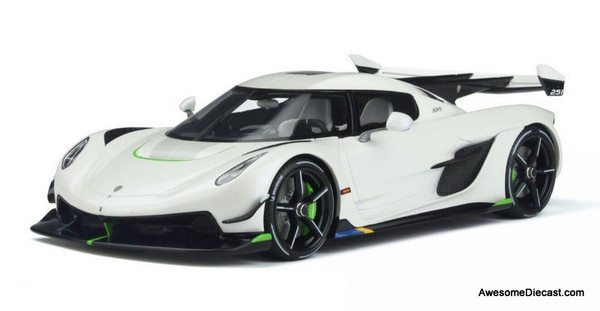


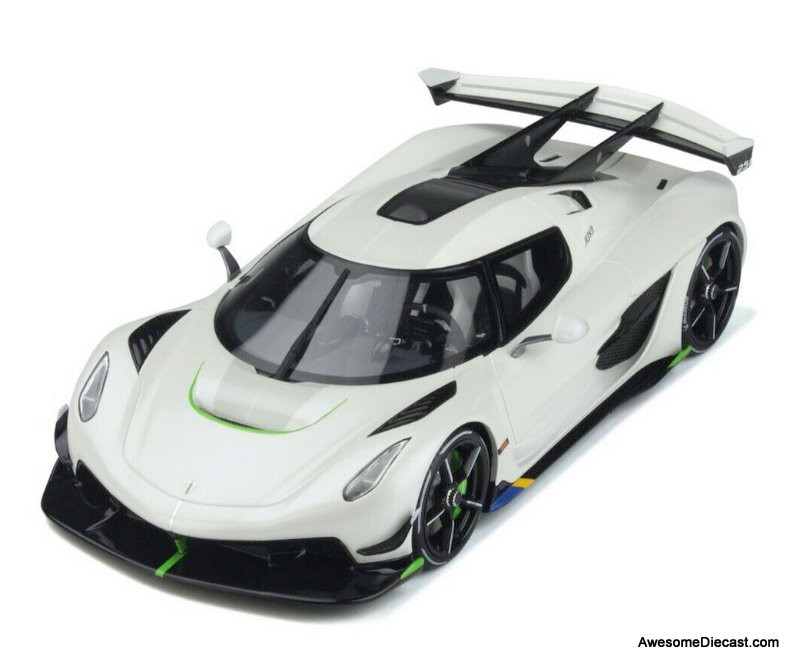


GT Spirit 1:18 Koenigsegg Jesko, White
$179.47
This is a highly detailed resin model
The Koenigsegg Jesko is a limited production mid-engine sports car produced by Swedish automobile manufacturer Koenigsegg. Introduced at the 2019 Geneva Motor Show, the car succeeds the Agera. The name Jesko is a tribute to the company founder's father, Jesko von Koenigsegg.
The automobile is named after Jesko von Koenigsegg, the father of Christian von Koenigsegg
The Jesko is primarily built as a high-performance track-focused car with an emphasis on high aerodynamic downforce and precise handling. Another Koenigsegg model, the Regera, is designed as a grand touring-oriented offering. The Jesko Attack and Jesko Absolut are both road legal worldwide.
The engine is a development of the 5.0-litre twin-turbocharged V8 engine used in the Agera. It has four valves per cylinder each with a bore and stroke of 92 mm × 95.25 mm (3.62 by 3.75 inches) and a compression ratio of 8.6:1. The engine has a power output of 955 kW (1,298 PS; 1,281 hp) at 7800 rpm and 1,000 N⋅m (738 lb⋅ft) of torque at 2700 to 6170 rpm on normal gasoline and has a power output of 1,195 kW (1,625 PS; 1,603 hp) and 1,500 N⋅m (1,106 lb⋅ft) of torque at 5,100 rpm on E85 biofuel.
Changes from the Agera's engine include the use of a new 180-degree flat-plane crankshaft that saves 5 kg (11 lb) and increases the redline from 8,250 rpm to 8,500 rpm. The Jesko also utilises active rubber mounts from the Regera that reduce engine vibrations in the cabin. The two large turbochargers are equipped with a 20-litre air tank made from carbon fibre, coupled with an electric compressor which feeds pressurised air to the turbochargers at a pressure of 20 bar (290 psi) in order to reduce turbo lag. The engine has pressure sensors for each cylinder in order to achieve real time cylinder monitoring for the multipoint fuel injection system.
The engine is mated to an in-house developed 9-speed multi-clutch transmission called the "Light Speed Transmission (LST)" by the manufacturer. The new transmission has a weight of 90 kg (198 lb) and it is at least 50% shorter in length than the previous 7-speed dual-clutch unit. It has 9 forward gear combinations using a layout with an input shaft with 3 fixed gears which is mated to a secondary shaft with 3 gears fixed to the output shaft and 3 clutched gears mated to the input shaft and an output shaft with 4 clutched gears (one set is used for reverse which mates directly to the input shaft), allowing the transmission to change gears without an interruption in power delivery due to the speedy nature of clutch actuation and overlap between the clutches opening and closing. The engine's crankshaft is mated directly to the LST and uses the rotating mass of the transmission components in place of a traditional flywheel. The transmission has a shift time ranging from 20 to 30 milliseconds. It also has an overdrive mode called "Ultimate Power on Demand" that is designed to skip directly to the optimal gear depending on user input, rather than down or upshifting sequentially to that gear.
The transmission is controlled by an onboard computer which uses engine and road speed data to engage a gear. Gears are selected by the driver either using the shift paddles mounted on the steering column or the gear selecto