Diecast metal with plastic parts
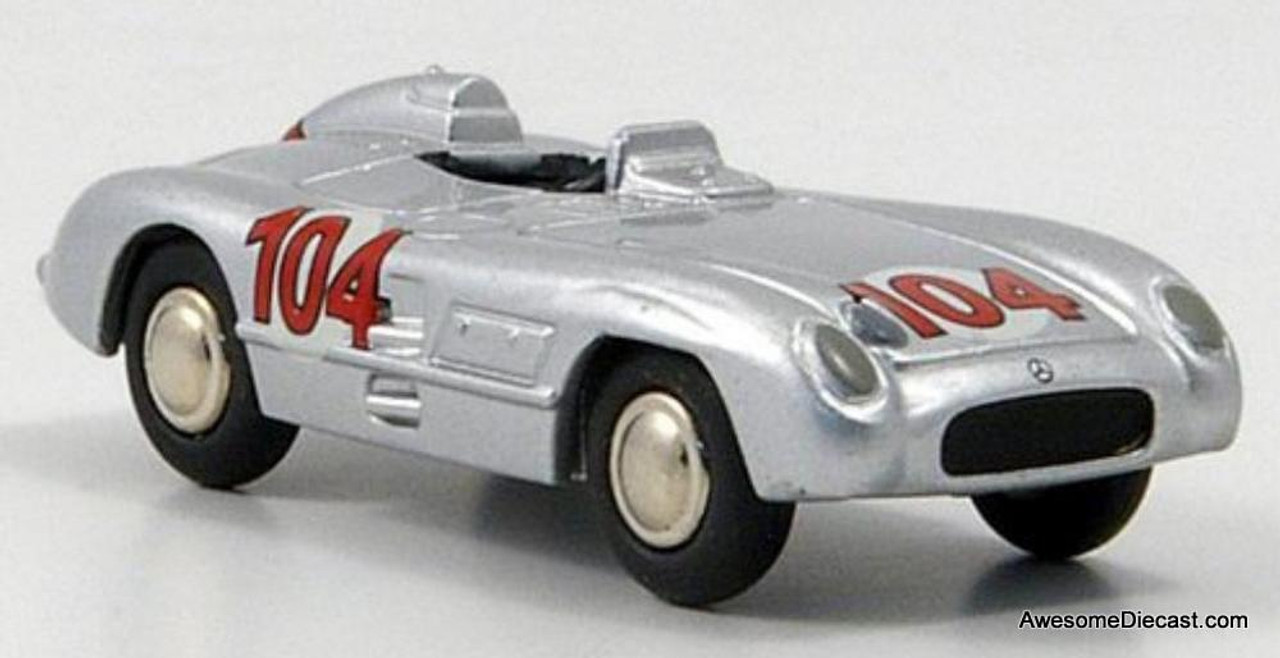
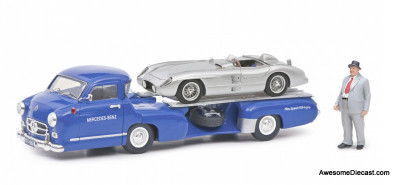
This is a high-quality replica of a Mercedes Benz 300 SLR race-car. This represents the car - numbered 104 - driven by Sir Stirling Moss & Peter Collins in the 1955 Targa Florio endurance race. There are black & white photographs of the real car in the race pits on the front & back of the box. This is a limited edition - one of 1000 pieces issued worldwide.
The Mercedes-Benz 300 SLR (W196S) was a 2-seat sports racer that took part in the World Sportscar Championship before a catastrophic crash and fire at Le Mans ended its domination prematurely.
Designated "SL-R" (for Sport Leicht-Rennen, eng: Sport Light-Racing, later condensed to "SLR"), the 3-liter engine was derived from the company's Mercedes-Benz W196 Formula One racer. It shared most of its drivetrain and chassis with the 196's fuel-injected 2,496.87 cc straight 8 bored and stroked to 2,981.70 cc and boosted to 310 bhp (230 kW).
The W196s monoposto driving position was modified to standard two-abreast seating, headlights were added, and a few other changes made to adapt a strictly track competitor to a 24-hour road/track sports racer.
Two of the nine 300 SLR rolling chassis produced were converted into 300 SLR/300 SL hybrids. Effectively road legal racers, they had coupé styling, gull-wing doors, and a footprint midway between the two models.
When Mercedes canceled its racing program after the Le Mans disaster, the hybrid project was shelved. Company design chief Rudolf Uhlenhaut, architect of both the 300 SLR racer and the hybrids, appropriated one of the leftover mules as his personal driver. Capable of approaching 290 km/h (180 mph), the Uhlenhaut Coupé was far and away the fastest road car in the world in its day.
Mercedes team driver Stirling Moss won the 1955 Mille Miglia in a 300 SLR, setting the event record at an average of 157.650 km/h (97.96 mph) over 1,600 km (990 mi). He was assisted by co-driver Denis Jenkinson, a British motor-racing journalist, who informed him with previously taken notes, ancestors to the pacenotes used in modern rallying. Teammate Juan Manuel Fangio was second in a sister car.
The 300 SLRs later scored an additional 1-2-3 world championship win in the Tourist Trophy at Dundrod, Ireland, and a 1-2 at the Targa Florio in Sicily, earning Mercedes victory in the 1955 World Sportscar Championship. Further non-championship trophies were also scored at the Eifelrennen in Germany, and Swedish Grand Prix.
However, these impressive victories became overshadowed at Le Mans when the once again leading 300 SLRs were withdrawn after a horrific accident involving a team car driven by Pierre Levegh. Even with the innovative wind-brake, the car's drum brakes had been unable to prevent Levegh from rear-ending an Austin-Healey, causing his car to become airborne. Upon impact, the ultra-lightweight Elektron bodywork's high magnesium content caused it to ignite and burn in the ensuing fuel fire. Compounding it, an uninformed race fire crew initially tried to extinguish it with water, only making it burn hotter. Eighty-four spectators and Levegh lost their lives in what remains the highest-fatality accident in the history of motorsport. Mercedes immediately withdrew from race competition, a ban which lasted three decades.