










Premium X
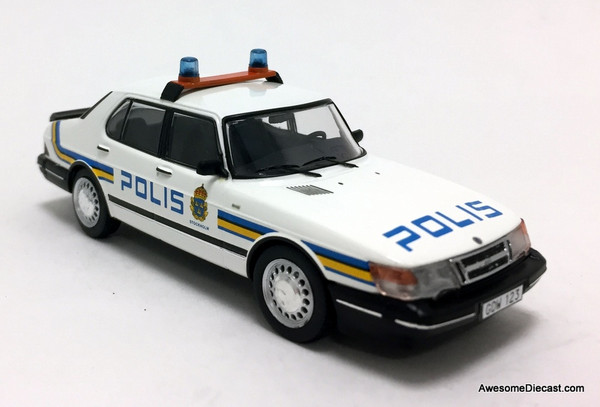
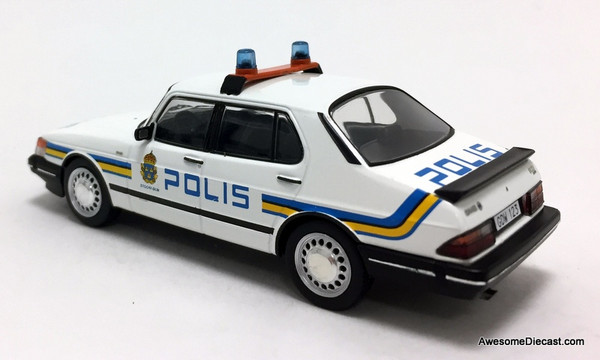
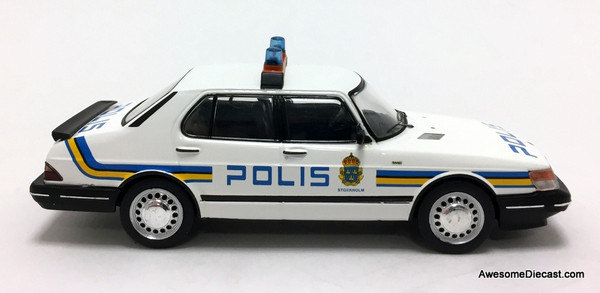
RARE!! Premium X 1:43 1987 Saab 900i: Stockholm Police Department

RARE!! Premium X 1:43 1987 Saab 900i: Stockholm Police Department
£44.72
The Saab 900 is a mid-sized automobile which was produced by Saab from 1978 until 1998 in two generations. The first generation from 1978 to 1994 is known as the "classic" and the generation from 1994 to 1998 is known as the "new generation".
The "classic" Saab 900 was based on the Saab 99 chassis, though with a longer front end to meet U.S. frontal crash regulations. The 900 was produced in 2- and 4-door sedan, and 3- and 5-door hatchback configurations and, from 1986, as a cabriolet (convertible) model. There were single- and twin-Zenith carburettor, fuel injected, and turbocharged engines, including both Full Pressure Turbo (FPT), and, in European models during the early 1990s, Low Pressure Turbos (LPT).
The Saab 900 is a front-engine, front-wheel-drive compact car with a longitudinally mounted, 45-degree slanted, inline four-cylinder engine, double wishbone front suspension and beam-axle rear suspension. It was originally introduced on 12 May 1978, for the 1979 model year.[1] Sales commenced in the fall of 1978.[2]
Like its predecessor the 99, the 900 contained a number of unusual design features that distinguish it from most other cars. First, the B-engine, that was installed "backwards", with power delivered from the crank at the front of the car. Second, the transmission, technically a transaxle, bolted directly to the bottom of the engine to form the oil pan (albeit with separate oil lubrication). Thus, power from the crank would be delivered out of the engine at the front, then transferred down and back to the transmission below, via a set of chain-driven primary gears. In similar fashion, Minis also had their gearbox mounted directly below the engine; however, the Mini gearbox and engine shared the same oil, whereas the Saab 900 (and 99) gearboxes contained a separate sump for engine oil.
Refined over several decades of two-digit Saab models, the 900's double wishbone suspension design provided excellent handling and road feel. The rear suspension comprised a typical beam axle design, stabilized with a Panhard rod. However, the attachment points between the axle and chassis made up an unusual configuration that, in essence, consists of two Watt's linkages at either end of the axle: A lower control arm attaches the axle to the bottom of the vehicle, while an upper link attaches at the top but faces towards the rear, unlike a typical four-link design with both lower and upper links facing forward.
Early models did not have sway bars; they began appearing on certain models in 1985, and, in U.S. and possibly other markets, became standard on all trim levels by the late 1980s. The sway bars decreased body roll, but at the expense of some ride comfort and when driven aggressively, increased inside wheel spin. The front and rear bars' diameters were unchanged throughout the model's run.
The 900 utilized a deeply curved front windshield, providing the best driver visibility, calling attention to the marque's aircraft legacy. Also underscoring their aircraft lineage, the 900's dashboard was curved to enable easy reach of all controls and featured gauges lit up from the front. Saab engineers placed all controls and gauges in the dashboard according to their frequency of use and/or importance so that the driver need only divert his gaze from the road for the shortest possible time and by the smallest angle. This is why, for example, the oft-used radio is placed so high in the dashboard. In keeping with the paradigm of its predecessor, the 99 model, the 900 employed a door design unique in automotive manufacturing, with an undercutting sweep to meet the undercarriage, forming a tight, solid unit when the door was closed. This feature also eliminated the stoop in the cabin at the footing of the door, as seen in automobiles of other manufacturers, thereby preventing water and debris from collecting and possibly entering the cabin or initiating corrosion, as well as enabling passengers to enter and exit the cabin without need to step over several inches of ledge.
The 900 underwent minor cosmetic design changes for 1987, including restyled front-end and bumpers that went from a vertical to a more sloped design; sheet metal body parts were unchanged. Being a small car factory, for economic reasons, Saab kept the basic undercarriage more or less unchanged throughout the 900's production run.