







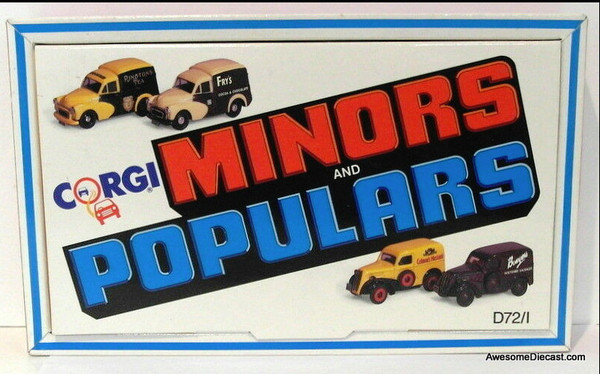


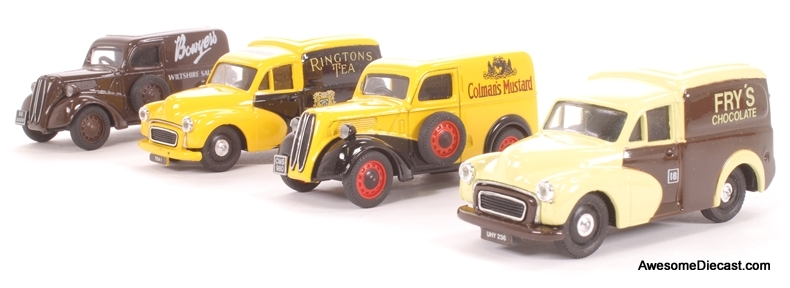
Corgi 1:43 Minors And Populars, 4 Vehicle Set
$1,058.30
The Morris Minor is a British car that made its debut at the Earls Court Motor Show, London, on 20 September 1948. Designed under the leadership of Alec Issigonis, more than 1.6 million were manufactured between 1948 and 1972 in three series: the MM (1948 to 1953), the Series II (1952 to 1956) and finally the 1000 series (1956 to 1971).
Initially available as a two-door saloon and tourer (convertible), the range was expanded to include a four-door saloon in 1950, a wood-framed estate car (the Traveller) from October 1953 and panel van and pick-up truck variants from May 1953. It was the first British car to sell over one million units and is considered a classic example of automotive design, as well as typifying "Englishness".
This is a 4 vehicle set comprising of 2 Morris minor vans and 2 Ford popular vans
The Ford Popular, often called the Ford Pop, is a car from Ford UK that was built in England between 1953 and 1962. When launched, it was Britain's lowest priced car.
The name Popular was also used by Ford to describe its 1930s Y Type model. The Popular name was also later used on basic models of the Escort and Fiesta cars.
Electrics were 6 volts, a provided starting handle often necessary. Rod operated drum brakes, synchromesh only on 2nd and top gear. The boot accessed with a coach key, no heater or demister, semaphore indicators, pull-wire starter, manual choke. No water pump, engine cooling by thermosyphon – this was very basic motoring.
When production of the older Ford Anglia and Ford Prefect was stopped in 1953 the Popular was developed as a budget alternative, based on the old, pre-war style E494A Anglia. The E494A was, in turn, a facelift of the Anglia E04A, which was a facelifted version of the 7Y, itself a rebodied Model Y. Thus through several adjustments, updates and name changes, a design with provenance dating back to 1932 was produced by Ford for 27 years. It was powered by a Ford Sidevalve 1172 cc, 30 bhp (22 kW),[4] four-cylinder engine. The car was very basic. It had a single vacuum-powered wiper, no heater, vinyl trim, and very little chrome; even the bumpers were painted, and the bakelite dash of the Anglia was replaced by a flat steel panel. The Popular 103E differed visually from the Anglia E494E in having smaller headlights and a lack of trim on the side of the bonnet. Early 103Es had the three spoke banjo type Anglia/Prefect steering wheel as stocks of these were used up, but most have a two spoke wheel similar to the 100E wheel but in brown. Early Populars also had the single centrally mounted tail/stop-lamp of the Anglia, but this changed to a two tail/stop lamp set up with the lamps mounted on the mudguards and a separate number plate lamp. In total, 155,340 Popular E103s were produced.
This car proved successful because, while on paper it was a sensible alternative to a clean, late-model used car, in practice there were no clean late-model used cars available in postwar Britain owing to the six-year halt in production caused by the Second World War. This problem was compounded by stringent export quotas that made obtaining a new car in the late 1940s and into the early 1950s difficult, and covenants forbidding new-car buyers from selling for up to three years after delivery. Unless the purchaser could pay the extra £100 or so for an Anglia 100E, Austin A30 or Morris Minor, the choice was the Popular or a pre-war car.
In later years, these cars became popular as hot rods since the late 1950s when people started drag racing them due to their lightweight construction. This practice started in the United States with Ford's 1932 Model B/18, while the Ford "Pop" as it was affectionately known became the definitive British hot rod – a reduced sized but readily available British alternative, a role it still plays today to a considerable extent.
A car tested by The Motor magazine in 1954 had a top speed of 60.3 mph (97.0 km/h) and could accelerate from 0-50 mph (80 km/h) in 24.1 seconds. A fuel consumption of 36.4 miles per imperial gallon (7.8 L/100 km; 30.3 mpg‑US) was recorded. The test car cost £390 including taxes.
Ringtons is a tea manufacturing business based in Newcastle upon Tyne, North East England. It was founded in 1907 by Samuel Smith and delivered tea across the nation through a door to door service which still continues today. Although famous for tea, Ringtons soon sold other groceries and products including coffee, biscuits and sweets.
Samuel Smith was born in Leeds in 1872 and grew up in a small cottage on Ladypit Lane. With an initial investment of £250, Sam Smith started Ringtons with his business partner William Titterington in the Heaton area of Newcastle upon Tyne. An initial stock of tea was purchased and the business begun, delivering direct to customers' homes.
The business soon flourished and Sam moved to larger premises, buying out William's share of the business. Ringtons truly became a family company when Sam's son Douglas Smith joined starting as a van boy.
In 1914 World War I hit and with it came the advent of rationing and Rington's workers called up to the front. These developments almost put a stop to trade and Sam Smith found himself diversifying the Ringtons range to include dried eggs, baking powder, canned meats, fish and pickles. After the war, there was a rebirth of the business and Sam Smith wherever possible employed ex-servicemen and opened up 48 depots as his business grew.
With a post-war boom in business Sam opened a purpose-built factory and six-storey head office in Algernon Road, Newcastle upon Tyne in 1926. The business continued to grow and in 1935 Ringtons expanded the tea packing department and built a packing factory on the site of the house where he had been born in Leeds.
Although the business was expanding and everyone was working hard through difficult economic times, Sam ensured that his employees' welfare was paramount and as an annual event trips to Scarborough were enjoyed by the staff and their families as a reward for all of their efforts.
World War II brought with it a succession of severe setbacks for the business and over 400 Ringtons' employees were called to the forces including Sam's grandsons. Sam donated his own car to the ambulance corps and the company was compelled to take 200 vans off the road in 1943. Samuel Smith was not to witness the historic changes that were to follow in the post war era. He died on 12 August 1949, aged 77. His will left sons Douglas and Malcolm with shares in the business and at the age of 50 Douglas took over Ringtons, to be joined by sons Norman, Douglas Junior and Jonnie.
In 1972, Douglas’s son Johnnie took over at Ringtons and when he began this new role his eldest son Nigel also joined the business as a Trainee Buyer. In 1975, Ringtons won an account to supply to Marks and Spencer (which they continue to do today). The decade was rounded off by a VIP visit to Algernon Road from none other than 'Iron Lady' Margaret Thatcher in 1979. The Conservative leader told of her preference for tea bags, noting they are "much more convenient". Throughout the 80's, Nigel's brothers Simon and Colin joined the business and were able to gain valuable and expert knowledge from all over the world. Over the next 30 years, the fourth generation of the Smith family brought in many changes, including the introduction of innovative vacuum-packing techniques (to deliver a truly fresh cuppa from the tea gardens of Kenya) and the construction of a custom-built factory in North Tyneside.
Bowyers was a company making meat products including a well-known brand of sausages in Trowbridge, Wiltshire, England. The company was acquired by a larger food manufacturer in 1985, and passed through two other owners until the Trowbridge factory was closed in 2007. Today the brand is used by Addo Food Group for ranges of sausage rolls, pork pies and quiches.
In 1805, Abraham Bowyer set up a grocers shop in Trowbridge. He became well known for his meat products, and particularly his sausages. As his business developed, Bowyer began to specialise in meat products. Merged with Wiltshire Bacon in Chippenham and Calne, and Harris in Calne, Bowyers became part of the Marsh Bodiner Group. This allowed a capital injection which resulted in the company's move into Innox Mill, Trowbridge in 1954.
Acquired by Northern Foods in 1985, it was merged in 1990 with Palethorpes of Market Drayton into new company Pork Farms Bowyers. In 2001, the Bowyers and Palethorpes pork sausage business and brands were sold to Kerry Group, to allow the company to concentrate on baked meat products.
The company was bought by private equity firm Vision Capital in 2007, as part of a £160 million divestment by Northern Foods. With European Union laws requiring Melton Mowbray pork pies to be produced within a defined distance of Melton Mowbray, the company chose to close the Trowbridge plant with the loss of 400 jobs, and invest £12 million into the Nottingham plant to increase Melton Mowbray pie production. Some employees were subsequently offered jobs in the Pork Farms plant at Shaftesbury.
In 2015, Vision Capital combined Bowyers with other chilled savoury pastry brands under Addo Food Group. In 2017, Addo was sold to Lloyds Development Capital, another private equity firm.
Colman's (est. in 1814) is an English manufacturer of mustard and other sauces, based at Carrow, in Norwich, Norfolk. Owned by Unilever since 1995, Colman's is one of the oldest existing food brands, famous for a limited range of products, almost all varieties of mustard.
In the early 1800s, Jeremiah Colman began making mustard at a water mill near Norwich in the village of Bawburgh. To create a tangy flavour, he blended brown mustard (Brassica juncea) with white mustard (Sinapis alba).
Jeremiah founded Colman's of Norwich in 1814, at the Stoke Holy Cross mill on the River Tas, four miles south of Norwich. In 1823 he took his adopted nephew, James, into the business which became J. & J. Colman.
In 1851 J.J. Colman took over the business. By 1865 production had transferred to a large factory at Carrow Road on land at Thorpe Hamlet, bought from the Norfolk Railway to the south of Norwich, where the firm still operates today.
From 1855 the firm introduced its distinctive yellow packaging and bull's head logo, and in 1866 was granted the Royal Warrant as manufacturers of mustard to Queen Victoria. Her Majesty's household still uses Colman's today.
The Colman family's pioneering achievements in social welfare are part of Norwich's history. In 1857 a school was opened for the employees' children, while in 1864 the firm employed a nurse to help sick members of staff—a social revolution at the time.
From 1896 Sir Jeremiah Colman became chairman. In 1903, the firm took over rival mustard maker Keen Robinson & Company, through which it also acquired the Robinsons barley water and baby food business. The purpose of the acquisition was to reduce competition within the mustard business.
By 1909 the company employed 2,300 people.
Keen's production was moved from London to Norwich in 1925.
Together with Reckitt, the company acquired French's, the American mustard manufacturer, in 1926 for £750,000.
In 1938 it merged with Reckitts and Sons of Hull to form the Reckitt & Colman household products conglomerate.
From 1997 to 2001, Colman's were the main sponsors of Norwich City Football Club.
The Colman's part of the business was demerged in 1995 and Colman's became part of Unilever UK Ltd. As well as mustard, it applies its name to condiments, sauces and other foodstuffs. Reckitt and Colman engaged in aggressive cost-cutting as it prepared to sell the brand, getting rid of the agronomy department, which had looked after plant breeding and seed development.
Colman's maintains links with Norwich. The founding family are commemorated in street names such as Colman Road (part of the A140 inner ring road), on which is situated Colman's First and Middle Schools. In addition, the Colman House residence at the University of East Anglia is named after the company and Jeremiah Colman.
J. S. Fry & Sons, Ltd. was a British chocolate company owned by Joseph Storrs Fry and his family. The business went through several changes of name and ownership; it was named J. S. Fry & Sons in 1822. In 1847, Fry's produced the first solid chocolate bar. The company also created the first filled chocolate sweet, Cream Sticks, in 1853. Fry is most famous for Fry's Chocolate Cream, the first mass produced chocolate bar which was launched in 1866, and Fry's Turkish Delight, launched in 1914.
Fry, alongside Cadbury and Rowntree's, were the big three British confectionery manufacturers throughout much of the nineteenth and twentieth centuries. The company became a division of Cadbury in the early 20th century. The original Somerdale Factory, then part of Cadbury's, was closed after the 2010 takeover of Cadbury's by Kraft Foods, now Mondelez International.
Joseph Fry, a Quaker, was born in 1728. He started making chocolate around 1759. In 1761 Joseph Fry and John Vaughan purchased a small shop from an apothecary, Walter Churchman, and with it the patent for a chocolate refining process. The company was then named Fry, Vaughan & Co.. In 1777 their chocolate works moved from Newgate Street to Union Street, Bristol. Joseph Fry died in 1787 and the company was renamed Anna Fry & Son. In 1795 Joseph Storrs Fry assumed control of the company. He patented a method of grinding cocoa beans using a Watt steam engine. As a result, factory techniques were introduced into the cocoa business. In 1803 Anna Fry died and Joseph Storrs Fry partnered with a Dr. Hunt. The business was renamed Fry & Hunt. In 1822 Hunt retired and Joseph Storrs Fry took on his sons Joseph, Francis and Richard as partners: the firm was renamed J. S. Fry & Sons. The company became the largest commercial producer of chocolate in Britain. In 1835 Joseph Storrs Fry died and his sons took full control.
In 1847, the Fry's chocolate factory, located in Union Street, Bristol, moulded a chocolate bar suitable for large-scale production. The firm began producing the Fry's Chocolate Cream bar in 1866. Over 220 products were introduced in the following decades, including production of the first chocolate Easter egg in UK in 1873 and the Fry's Turkish Delight (or Fry's Turkish bar) in 1914. In 1896 the firm became a registered private company. It was run by the Fry family, with Joseph Storrs Fry II, grandson of the first Joseph Storrs Fry, as the chairman.
In 1881, an employee of Fry's H. J. Packer established his own chocolate business in Bristol. At its eventual home in Greenbank, Bristol, Packer's Chocolate continued to provide local competition for Fry's until 2006, under various owners and brands, from Bonds through to Famous Names and Elizabeth Shaw.
Near the start of World War I the company was one of the largest employers in Bristol. Joseph Storrs Fry II died in 1913. By 1919 the company merged with Cadbury's chocolate and the joint company named British Cocoa and Chocolate Company. Under Egbert Cadbury the Fry's division began the move to Somerdale, Keynsham in 1923. After 1981 the name Fry's was no longer in use at Somerdale, but the factory was still a major producer of Cadbury's products.
On 3 October 2007, Cadbury announced plans to close the Somerdale plant, the historic home of the Fry's Factory, by 2010 with the loss of some 500 jobs. In an effort to maintain competitiveness in a global marketplace, production was to be moved to a new factory in Poland. Another motivational factor was the high value of the land. Labour MP for Wansdyke, Dan Norris, said, "News of the factory's closure is a hard and heavy blow, not just to the workforce, but to the Keynsham community as a whole".
In February 2010, following the takeover of Cadbury plc by Kraft Foods, the closure was controversially confirmed to take place in 2011; Kraft had specifically agreed during the takeover battle to keep the site open. There was widespread outrage in the press and later a House of Commons Select Committee investigation into the affair.