









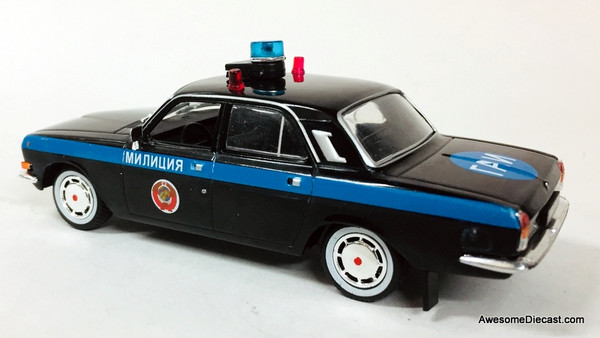


DeAgostini 1:43 Gaz 24-10 Volga Gai Special Issue: Moscow Police Department
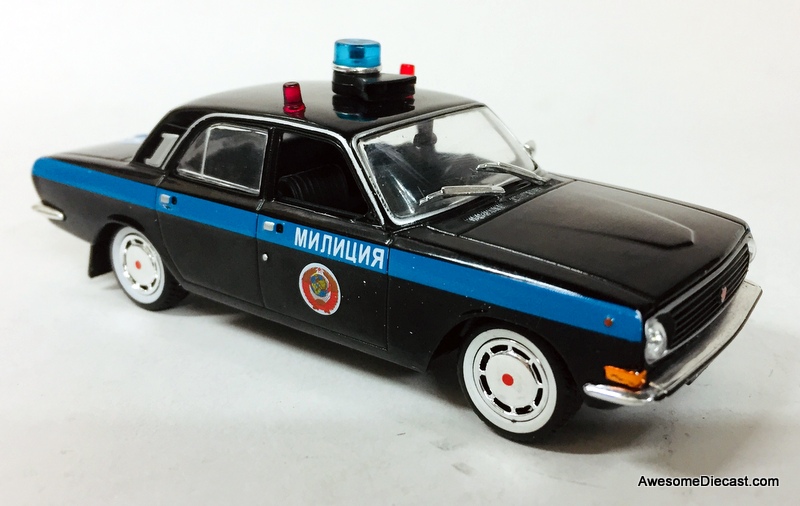
DeAgostini 1:43 Gaz 24-10 Volga Gai Special Issue: Moscow Police Department
€43.56
This model is sold in a blister pack
Volga (Russian: Волга) is an Executive car that originated in the Soviet Union to replace the venerated GAZ Pobeda in 1956. Their role in serving the Soviet nomenklatura made them a contemporary cultural icon. Several generations of the car have been produced.
Despite the continuous modernisations, GAZ found it increasingly difficult to keep the ageing design competitive in a market economy. GAZ CEO Bo Andersson decided to discontinue the Volga range in 2010.
Design of GAZ-21's replacement began in the early 1960s, and original sketches showed an evolution from the contoured body of the early 1960s to the more angular and rigid profile. The M24 was to introduce the popular measure economy of scale into the model range, where the same body would house different powertrains, mechanics and interior trim, and hence could me marketed as separate cars (platform sharing). GAZ hoped to employ this on the new Volga and a range was drawn where the entry model would carry the traditional, though modernised, four cylinder engine and manual transmission (the prototype appeared with a 120 hp (89 kW; 122 PS) 2,990 cc (182 cu in) V6). The first prototypes were built in 1966, and a year later the car was certified for production. For economic reasons a V6 model, despite showing promising results, was deemed unfeasible for mass production. The first batch of 24 vehicles were assembled in 1968, 215 more followed in 1969 and in a public ceremony held on 15 July 1970 the car superseded the GAZ-21 on conveyor without halting it.
Despite its more imposing appearance, the GAZ-24 was in fact 75 mm (3.0 in) shorter in length and 120 mm in height, yet its wheelbase was extended by 10 mm. The lower body waist line, allowed the window area was to be increased, whilst using thinner linings in doors, roof and other body panels, notably increased interior space. The combination of this progressive design and a lower clearance gave it a much lighter and more elegant aura.
The car was powered by a 2,445 cc (149.2 cu in)[44] ZMZ-24D engine, an evolution of the ZMZ-21A. Retaining the basic OHV configuration, it now ran on 92 RON gasoline (while the ZMZ 24-01 could use commonly available 76 octane, and the 24-07 could use liquid propane).[45] The cylinder block was die cast, instead of the slower coquille for the 21A. The engine featured a twin-choke carburettor, with a higher compression ratio, producing 95 hp (71 kW; 96 PS) at 4500 rpm and an even more impressive 186 N⋅m (137 ft⋅lbf) of torque at 2200–2400 RPM. Transmission was now fully synchronised four on floor layout. The brakes were improved, with a hydraulic vacuum servo unit (a licence-built Girling PowerStop), as well as an independent parking brake (rather than transmission brake of the GAZ-21). At the same time, certain features were retained for their proven reliability, like the kingpin front suspension and recirculating ball steering.