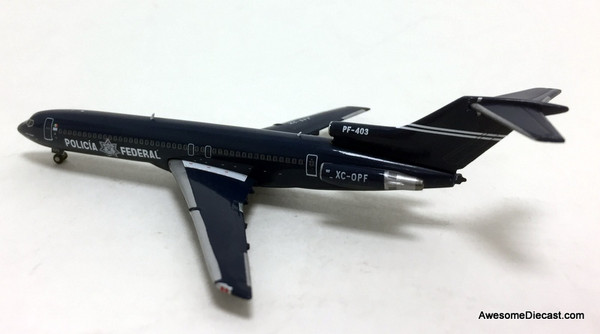
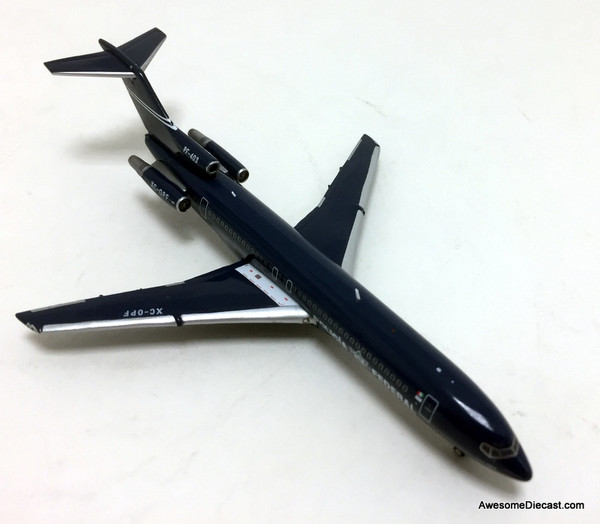
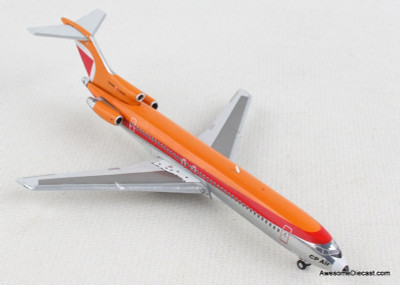
The Boeing 727 is a narrow-body airliner produced by Boeing Commercial Airplanes. After the heavy 707 quad-jet was introduced in 1958, Boeing addressed the demand for shorter flight lengths from smaller airports. On December 5, 1960, the 727 was launched with 40 orders each from United Airlines and Eastern Air Lines. The first 727-100 rolled out November 27, 1962, first flew on February 9, 1963, and entered service with Eastern on February 1, 1964.
Boeing's only trijet is powered by Pratt & Whitney JT8D low-bypass turbofans below a T-tail, one on each side of the rear fuselage and a center one fed through an S-duct. It shares its six-abreast upper fuselage cross-section and cockpit with the 707. The 133ft (40.6m) long 727-100 typically carries 106 passengers in two classes over 2,250 nmi (4,170 km), or 129 in a single class. Launched in 1965, the stretched 727-200 flew in July 1967 and entered service with Northeast Airlines that December. The 20 ft (6m) longer variant typically carries 134 passengers in two classes over 2,550 nmi (4,720 km), or 155 in a single class. Besides the airliner accommodation, a freighter and a Quick Change convertible version were offered.
The 727 was used for many domestic flights and on some international flights within its range. Airport noise regulations have led to hush kit installations. Its last commercial passenger flight was in January 2019. It was succeeded by the 757-200 and larger variants of the 737. As of July 2018, a total of 44 Boeing 727s (2× 727-100s and 42× -200s) were in commercial service with 23 airlines, plus some in government and private use. There have been 118 fatal incidents involving the Boeing 727. Until the last one in September 1984, 1,832 have been built.
The Boeing 727 design was a compromise among United Airlines, American Airlines, and Eastern Air Lines; each of the three had developed requirements for a jet airliner to serve smaller cities with shorter runways and fewer passengers. United Airlines requested a four-engine aircraft for its flights to high-altitude airports, especially its hub at Stapleton International Airport in Denver, Colorado. American Airlines, which was operating the four-engined Boeing 707 and Boeing 720, requested a twin-engined aircraft for efficiency. Eastern Airlines wanted a third engine for its overwater flights to the Caribbean, since at that time twin-engine commercial flights were limited by regulations to routes with 60-minute maximum flying time to an airport (see ETOPS). Eventually, the three airlines agreed on a trijet design for the new aircraft.
The airliner's middle engine (engine 2) at the very rear of the fuselage gets air from an inlet ahead of the vertical fin through an S-shaped duct. This S-duct proved to be troublesome in that flow distortion in the duct induced a surge in the centerline engine on the take-off of the first flight of the 727-100. This was fixed by the addition of several large vortex generators in the inside of the first bend of the duct.
The 727 was designed for smaller airports, so independence from ground facilities was an important requirement. This led to one of the 727's most distinctive features: the built-in airstair that opens from the rear underbelly of the fuselage, which initially could be opened in flight. Hijacker D. B. Cooper used this hatch when he parachuted from the back of a 727, as it was flying over the Pacific Northwest. Boeing subsequently modified the design with the Cooper vane so that the airstair could not be lowered in flight. Another innovation was the auxiliary power unit (APU), which allowed electrical and air-conditioning systems to run independently of a ground-based power supply, and without having to start one of the main engines. An unusual design feature is that the APU is mounted in a hole in the keel beam web, in the main landing gear bay. The 727 is equipped with a retractable tailskid that is designed to protect the aircraft in the event of an over-rotation on takeoff. The 727's fuselage has an outer diameter of 148 inches (3.8 m). This allows six-abreast seating (three per side) and a single aisle when 18-inch (46 cm) wide coach-class seats are installed. An unusual feature of the fuselage is the 10-inch (25 cm) difference between the lower lobe forward and aft of the wing as the higher fuselage height of the center section was simply retained towards the rear.
Nosewheel brakes were available as an option to reduce braking distance on landing, which provided reduction in braking distances of up to 150 m.
The 727 proved to be such a reliable and versatile airliner that it came to form the core of many startup airlines' fleets. The 727 was successful with airlines worldwide partly because it could use smaller runways while still flying medium-range routes. This allowed airlines to carry passengers from cities with large populations, but smaller airports to worldwide tourist destinations. One of the features that gave the 727 its ability to land on shorter runways was its clean wing design. With no wing-mounted engines, leading-edge devices (Krueger, or hinged, flaps on the inner wing and extendable leading edge slats out to the wingtip) and trailing-edge lift enhancement equipment (triple-slotted, fowler flaps) could be used on the entire wing. Together, these high-lift devices produced a maximum wing lift coefficient of 3.0 (based on the flap-retracted wing area). The 727 was stable at very low speeds compared to other early jets, but some domestic carriers learned after review of various accidents that the 40-degree flap setting could result in a higher-than-desired sink rate or a stall on final approach. These carriers' Pilots' Operation Handbooks disallowed using more than 30° of flaps on the 727, even going so far as installing plates on the flap lever slot to prevent selection of more than 30° of flaps.
The 727 is one of the noisiest commercial jetliners, categorized as Stage 2 by the U.S. Noise Control Act of 1972, which mandated the gradual introduction of quieter Stage 3 aircraft. The 727's JT8D jet engines use older low-bypass turbofan technology, whereas Stage 3 aircraft use the more efficient and quieter high-bypass turbofan design. When the Stage 3 requirement was being proposed, Boeing engineers analyzed the possibility of incorporating quieter engines on the 727. They determined that the JT8D-200 engine could be used on the two side-mounted pylons. The JT8D-200 engines are much quieter then the original JT8D-1 through -17 variant engines that power the 727, as well as more fuel efficient due to the higher bypass ratio, but the structural changes to fit the larger-diameter engine (49.2 inches (125 cm) fan diameter in the JT8D-200 compared to 39.9 inches (101 cm) in the JT8D-1 through -17) into the fuselage at the number two engine location were prohibitive.
The Federal Police, formerly known as the Policía Federal Preventiva (Federal Preventive Police), was a Mexican national police force. It was under the authority of the Department of Security and Civil Protection. They were sometimes referred to by the slang term "Federales" or "Mexican feds" by some U.S. agents and media. Typically, agents of the Federal Police are heavily armed and wear dark blue, black, or gray combat fatigues. The Federal Police was officially dissolved and absorbed to the National Guard, a new national police institution created by president Andres Manuel Lopez Obrador, on 1 October 2019,
The Federal Preventive Police was created by the merger of four other federal organizations in 1998 and 1999 in order to better co-ordinate the fight against the growing threat of drug cartels. The agency merged the Federal Highway Police, the Fiscal Police, an Interior Ministry intelligence unit called the Investigation and National Security Center, and military personnel transferred en masse from the Mexican Army's 3rd Military Police Brigade.
On account of its heavily armed agents, its culture, and its origins, the Federal Police as a whole may be considered a gendarmerie. However, two of the seven "divisions" (i.e. branches of service) of the Federal Police have particularly military characteristics: The Federal Forces Division and the Gendarmerie Division. The Gendarmerie Division was created in 2014, and is legally defined as a military/police force within the Federal Police.
There is an investigation division within the Federal Police. Investigation of federal crimes can also be handled by the Federal Ministerial Police directed by the Attorney General of Mexico.