









Gemini Jets
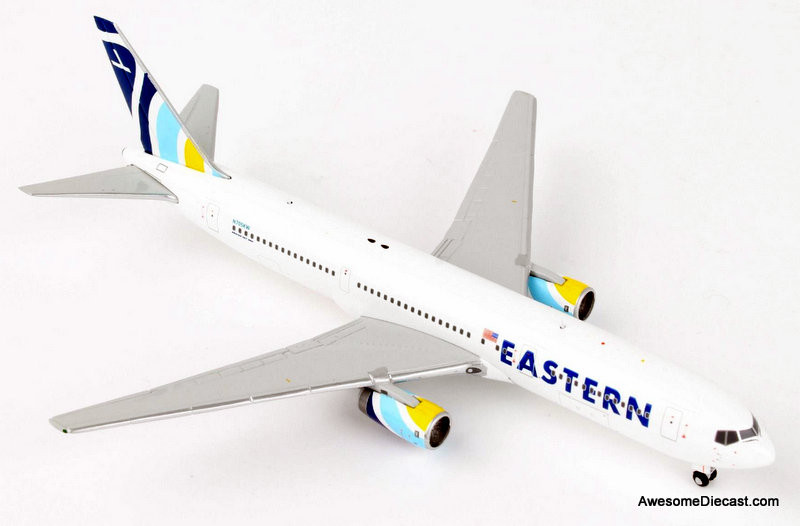
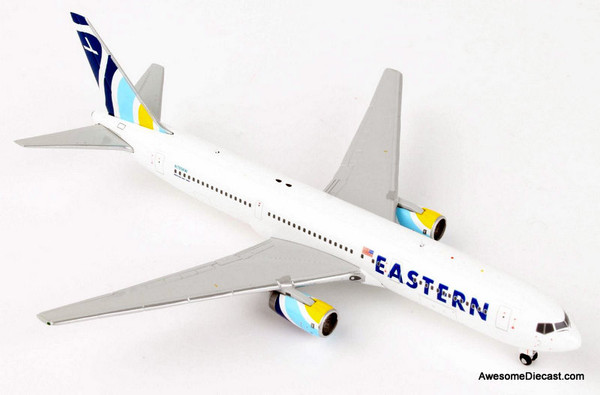
Gemini Jets 1:400 Boeing 767-300ER: Eastern Airlines


Gemini Jets 1:400 Boeing 767-300ER: Eastern Airlines
$39.95
The Boeing 767 is a wide-body airliner developed and manufactured by Boeing Commercial Airplanes. The airliner was launched as the 7X7 project on July 14, 1978, the prototype first flew on September 26, 1981, and it was certified on July 30, 1982. The original 767-200 entered service on September 8 with United Airlines, and the extended-range 767-200ER in 1984. It was stretched into the 767-300 in October 1986, followed by the 767-300ER in 1988, the most popular variant. The 767-300F, a production freighter version, debuted in October 1995. It was stretched again into the 767-400ER from September 2000.
To complement the larger 747, it has a seven-abreast cross-section, accommodating smaller LD2 ULD cargo containers. The 767 is Boeing's first wide-body twinjet, powered by General Electric CF6, Rolls-Royce RB211, or Pratt & Whitney JT9D turbofans. JT9D engines were eventually replaced by PW4000 engines. The aircraft has a conventional tail and a supercritical wing for reduced aerodynamic drag. Its two-crew glass cockpit, a first for a Boeing airliner, was developed jointly for the 757 − a narrow-body aircraft, allowing a common pilot type rating. Studies for a higher-capacity 767 in 1986 led Boeing to develop the larger 777 twinjet, introduced in June 1995.
The 159-foot-long (48.5 m) 767-200 typically seats 216 passengers over 3,900 nmi (7,200 km), while the 767-200ER seats 181 over a 6,590 nautical miles (12,200 km) range. The 180-foot-long (54.9 m) 767-300 typically seats 269 passengers over 3,900 nmi (7,200 km), while the 767-300ER seats 218 over 5,980 nmi (11,070 km). The 767-300F can haul 116,000 lb (52.7 t) over 3,225 nmi (6,025 km), and the 201.3-foot-long (61.37 m) 767-400ER typically seats 245 passengers over 5,625 nmi (10,415 km). Military derivatives include the E-767 for surveillance, the KC-767 and KC-46 aerial tankers. Passenger 767-200s and 767-300s have been converted for cargo use.
The 767-300ER, the extended-range version of the 767-300, entered service with American Airlines in 1988. The type's increased range was made possible by greater fuel tankage and a higher MTOW of 407,000 lb (185,000 kg). Design improvements allowed the available MTOW to increase to 412,000 lb (187,000 kg) by 1993. Power is provided by Pratt & Whitney PW4000, General Electric CF6, or Rolls-Royce RB211 engines. the 767-300ER comes in three exit configurations: the baseline configuration has four main cabin doors and four over-wing window exits, the second configuration has six main cabin doors and two over-wing window exits; and the third configuration has six main cabin doors, as well as two smaller doors that are located behind the wings. Typical routes for the type include Los Angeles to Frankfurt. The combination of increased capacity and range offered by the 767-300ER has been particularly attractive to both new and existing 767 operators. It is the most successful version of the aircraft, with more orders placed than all other variants combined. As of November 2017, 767-300ER deliveries stand at 583 with no unfilled orders. There were 376 examples in service as of July 2018. The type's main competitor is the Airbus A330-200.
At its 1990s peak, a new 767-300ER was valued at $85 million, dipping to around $12 million in 2018 for a 1996 build.
Eastern Air Lines, also colloquially known as Eastern, was a major American airline from 1926 to 1991. Before its dissolution, it was headquartered at Miami International Airport in an unincorporated area of Miami-Dade County, Florida
Eastern was one of the "Big Four" domestic airlines created by the Spoils Conferences of 1930, and was headed by World War I flying ace Eddie Rickenbacker in its early years. It had a near monopoly in air travel between New York and Florida from the 1930s until the 1950s and dominated this market for decades afterward.
In the late 1970s and early 1980s, during the deregulation, labor disputes and high debt loads strained the company under the leadership of former astronaut Frank Borman. Frank Lorenzo acquired Eastern in 1985 and moved many of its assets to his other airlines, including Continental Airlines and Texas Air. After continued labor disputes and a crippling strike in 1989, Eastern ran out of money and was liquidated in 1991.
American Airlines obtained many of Eastern's routes from Miami to Latin America and the Caribbean, while Delta Air Lines, Eastern's main competitor at Hartsfield Airport in Atlanta, acquired many of Eastern's Lockheed L-1011 aircraft. USAir acquired 11 of Eastern's 25 Boeing 757-225 aircraft.
Eastern pioneered hourly air shuttle service between New York City, Washington, DC and Boston in 1961 as the Eastern Air Lines Shuttle. It took over the South American route network of Braniff International upon its shutdown in 1982[5] and also served London Gatwick in 1985 via a DC-10 "Golden Wings" service. Although Eastern announced on their March 2, 1986 timetable that it would serve Madrid, Spain effective May 1, 1986, the service did not commence. The only scheduled trans-Atlantic service Eastern provided was Miami to London Gatwick, commencing on July 15, 1985 and was discontinued in 1986 and replaced with codeshare flights from Atlanta via British Caledonian Airways.