












Gemini Jets
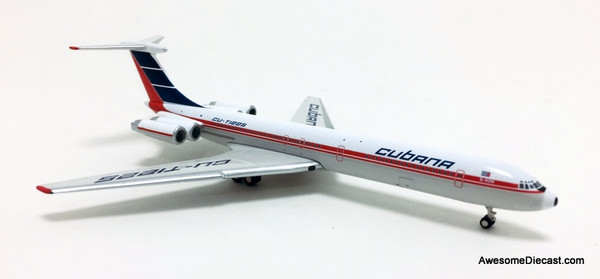
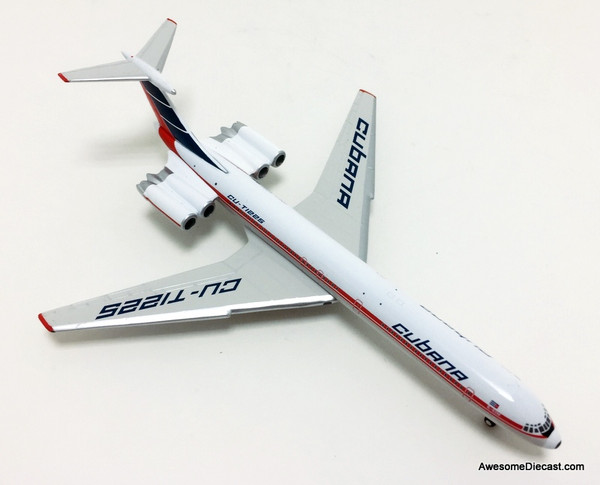
Gemini Jets 1:400 Ilyushin IL-62M: Cubana Airlines, Cuba

Gemini Jets 1:400 Ilyushin IL-62M: Cubana Airlines, Cuba
$39.95
The Ilyushin IL-62 is a Soviet long-range narrow-body jetliner conceived in 1960 by Ilyushin. As successor to the popular turboprop Il-18 and with capacity for almost 200 passengers and crew, the Il-62 was the world's largest jet airliner when first flown in 1963. One of four pioneering long-range designs (the others being Boeing 707, Douglas DC-8, and Vickers VC10), it was the first such type to be operated by the Soviet Union and a number of allied nations.
The Il-62 entered Aeroflot civilian service on 15 September 1967 with an inaugural passenger flight from Moscow to Montreal, and remained the standard long-range airliner for the Soviet Union (and later, Russia) for several decades. It was the first Soviet pressurised aircraft with non-circular cross-section fuselage and ergonomic passenger doors, and the first Soviet jet with six-abreast seating (the turboprop Tu-114 shared this arrangement) and international-standard position lights.
Over 30 nations operated the Il-62 with over 80 examples exported and others having been leased by Soviet-sphere and several Western airlines. The Il-62M variant became the longest-serving model in its airliner class (average age of examples in service as of 2016 is over 32 years). Special VIP (salon) and other conversions were also developed and used as head-of-state transport by some 14 countries. However, because it is expensive to operate compared to newer generation airliners, the number in service was greatly reduced after the 2008 Great Recession. The Il-62's successors include the wide-bodied Il-86 and Il-96, both of which were made in much smaller numbers and neither of which was widely exported.
The Il-62M variant (first flight in 1971, introduced in 1973) has more powerful, more efficient, and quieter Soloviev D-30KU engines and a fin fuel tank. Beneath the skin, the Il-62M has simpler and lighter single-slotted flaps and incremental aerodynamic improvements. Most important of these was the addition of spoilerons (spoilers or wing-mounted air brakes which act as ailerons by differential deployment in cruising flight) and the ability to use idle reverse thrust in flight during the final approach so as to shorten the landing run. All but one example in service today are Il-62M. In 1978, the Il-62MK was further developed to seat up to 198 passengers and carry some two tonnes (4,400 lb) more payload and/or fuel than the Il-62M.
Other versions were also planned, including a stretched version to seat up to 250 passengers and a shrunk version to suit smaller airfields.
The Il-62 has tricycle landing gear with an additional lightweight gear strut at the rear of the fuselage which extends when the aircraft reaches its parking position. Aircraft with rear-mounted engines are usually tail-heavy when sitting empty on the ground, and to prevent the aircraft from tipping up on its tail, various devices are used for supporting the tail - from simple "pogo stick" fixed struts on small aircraft, to light-weight extendable struts (Il-62). Aircraft like DC-9 or Boeing 727 use an airstair door under their tail which serves the dual purpose of a tail support as well as an extra door for passenger loading.
Cubana de Aviación S.A., commonly known as Cubana, is a national airline based in Cuba, as well as the country's largest airline. It was founded in October 1929, becoming one of the earliest airlines to emerge in Latin America. It has its corporate headquarters in Havana, and its main base is located at José Martí International Airport. Originally a subsidiary of Pan American World Airways and later a private company owned by Cuban investors, Cubana has been wholly owned by the Cuban government since May 1959 and celebrated its 80th anniversary in 2009.
Cubana was a founder and is a current member of the International Air Transport Association, the International Association of Aeronautical Telecommunications (SITA) and the International Association of Latin American Air Transportation (AITAL).