










Gemini Jets
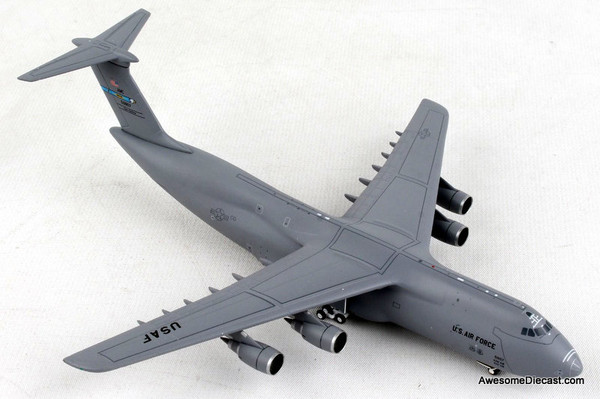
Gemini Macs 1:400 Lockhead C-5M Super Galaxy: United States Air Force

Gemini Macs 1:400 Lockhead C-5M Super Galaxy: United States Air Force
$59.95
The Lockheed C-5 Galaxy is a large military transport aircraft originally designed and built by Lockheed, and now maintained and upgraded by its successor, Lockheed Martin. It provides the United States Air Force (USAF) with a heavy intercontinental-range strategic airlift capability, one that can carry outsized and oversized loads, including all air-certifiable cargo. The Galaxy has many similarities to the smaller Lockheed C-141 Starlifter and the later Boeing C-17 Globemaster III. The C-5 is among the largest military aircraft in the world.
The C-5 Galaxy's development was complicated, including significant cost overruns, and Lockheed suffered significant financial difficulties. Shortly after entering service, cracks in the wings of many aircraft were discovered and the C-5 fleet was restricted in capability until corrective work was completed. The C-5M Super Galaxy is an upgraded version with new engines and modernized avionics designed to extend its service life beyond 2040.
The USAF has operated the C-5 since 1969. In that time, the airlifter supported US military operations in all major conflicts including Vietnam, Iraq, Yugoslavia, and Afghanistan, as well as allied support, such as Israel during the Yom Kippur War and operations in the Gulf War. The Galaxy has also been used to distribute humanitarian aid and disaster relief, and supported the US space program.
The first C-5A Galaxy (serial number 66-8303) was rolled out of the manufacturing plant in Marietta, Georgia, on 2 March 1968. On 30 June 1968, flight testing of the C-5A began with the first flight, flown by Leo Sullivan, with the call sign "eight-three-oh-three heavy". Flight tests revealed that the aircraft exhibited a higher drag divergence Mach number than predicted by wind tunnel data. The maximum lift coefficient measured in flight with the flaps deflected 40° was higher than predicted (2.60 vs. 2.38), but was lower than predicted with the flaps deflected 25° (2.31 vs. 2.38) and with the flaps retracted (1.45 vs. 1.52)
Aircraft weight was a serious issue during design and development. At the time of the first flight, the weight was below the guaranteed weight, but by the time of the delivery of the 9th aircraft, had exceeded guarantees. In July 1969, during a fuselage upbending test, the wing failed at 128% of limit load, which is below the requirement that it sustain 150% of limit load. Changes were made to the wing, but during a test in July 1970, it failed at 125% of limit load. A passive load-reduction system, involving uprigged ailerons, was incorporated, but the maximum allowable payload was reduced from 220,000 to 190,000 lb (100,000 to 86,000 kg). At the time, a 90% probability was predicted that no more than 10% of the fleet of 79 airframes would reach their fatigue life of 19,000 hours without cracking of the wing.
Cost overruns and technical problems of the C-5A were the subject of a congressional investigation in 1968 and 1969. The C-5 program has the dubious distinction of being the first development program with a $1‑billion (equivalent to $7 billion today) overrun. Due to the C-5's troubled development, the Department of Defense abandoned Total Package Procurement. In 1969, Henry Durham raised concerns about the C-5 production process with Lockheed, his employer. Subsequently, Durham was transferred and subjected to abuse until he resigned. The Government Accountability Office substantiated some of his charges against Lockheed. Later, the American Ethical Union honored Durham with the Elliott-Black Award. The Deputy Assistant Secretary of the Air Force for Management Systems, Ernest Fitzgerald, was another person whose fostering of public accountability was unwelcome.
Upon completion of testing in December 1969, the first C-5A was transferred to the Transitional Training Unit at Altus Air Force Base, Oklahoma. Lockheed delivered the first operational Galaxy to the 437th Airlift Wing, Charleston Air Force Base, South Carolina, in June 1970. Due to higher than expected development costs, in 1970, public calls were made for the government to split the substantial losses that Lockheed was experiencing. Production was nearly brought to a halt in 1971 due to Lockheed going through financial difficulties, due in part to the C-5 Galaxy's development, as well as a civilian jet liner, the Lockheed L-1011. The U.S. government gave loans to Lockheed to keep the company operational.
In the early 1970s, NASA considered the C-5 for the Shuttle Carrier Aircraft role, to transport the Space Shuttle to Kennedy Space Center. However, they rejected it in favor of the Boeing 747, in part due to the 747's low-wing design. In contrast, the Soviet Union chose to transport its shuttles using the high-winged An-225, which derives from the An-124, which is similar in design and function to the C-5.
During static and fatigue testing, cracks were noticed in the wings of several aircraft, and as a consequence, the C-5A fleet was restricted to 80% of maximum design loads. To reduce wing loading, load alleviation systems were added to the aircraft. By 1980, payloads were restricted to as low as 50,000 lb (23,000 kg) for general cargo during peacetime operations. A $1.5 billion program (equivalent to $6.7 billion today), known as H-Mod, to re-wing the 76 completed C-5As to restore full payload capability and service life began in 1976. After design and testing of the new wing design, the C-5As received their new wings from 1980 to 1987. During 1976, numerous cracks were also found in the fuselage along the upper fuselage on the centerline, aft of the refueling port, extending back to the wing. The cracks required a redesign to the hydraulic system for the visor, the front cargo entry point
Related Products


Gemini Jets
Gemini Macs 1:400 Lockheed C-130H: U.S Air Force (Delaware Air National Guard)
After World War II, the U.S. Military required a modern-day troop and cargo transport aircraft to replace its aging mixed fleet of piston-engine aging aircraft. On August 23, 1954, the first C-130A...