









Greenlight
Greenlight 1:64 1940 Willys MB Jeep: 80th Anniversary Edition
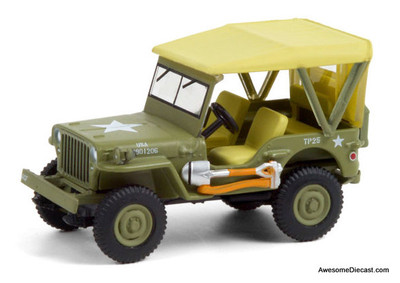

Greenlight 1:64 1940 Willys MB Jeep: 80th Anniversary Edition
$14.43
Willys was a brand name used by Willys–Overland Motors, an American automobile company best known for its design and production of military Jeeps (MBs) and civilian versions (CJs) during the 20th century.
In 1908, John Willys bought the Overland Automotive Division of Standard Wheel Company and in 1912 renamed it Willys–Overland Motor Company. From 1912 to 1918, Willys was the second-largest producer of automobiles in the United States after Ford Motor Company.
In 1913, Willys acquired a license to build the Charles Knight's sleeve-valve engine which it used in cars bearing the Willys–Knight nameplate. In the mid-1920s, Willys also acquired the F.B. Stearns Company of Cleveland and assumed continued production of the Stearns-Knight luxury car, as well.
John Willys acquired the Electric Auto-Lite Company in 1914 and in 1917 formed the Willys Corporation to act as his holding company. In 1916, it acquired the Russell Motor Car Company of Toronto, Ontario, by 1917, New Process Gear, and in 1919 acquired the Duesenberg Motors Company plant in Elizabeth, New Jersey. The New Jersey plant was replaced by a new, larger facility in Indianapolis, and was to be the site of production for a new Willys Six at an adjacent site, but the depression of 1920–21 brought the Willys Corporation to its knees. The bankers hired Walter P. Chrysler to sort out the mess and the first model to go was the Willys Six, deemed an engineering disaster. Chrysler had three auto engineers: Owen Skelton, Carl Breer, and Fred Zeder (later nicknamed The Three Musketeers) begin work on a new car, commonly referred to as the Chrysler Six.
To raise cash needed to pay off debts, many of the Willys Corporation assets were put on the auction block. The Elizabeth plant and the Chrysler Six prototype were sold to William C. Durant, then in the process of building a new, third empire. The plant built Durant's low-priced Star, while the Chrysler Six prototype was substantially reworked to become the 1923 Flint.
Walter Chrysler and the three engineers who had been working on the Chrysler Six all moved on to Maxwell-Chalmers where they continued their work, ultimately launching the six-cylinder Chrysler in January 1924. (In 1925, the Maxwell car company became the Chrysler Corporation.)
After the war, Willys did not resume production of its passenger-car models, choosing instead to concentrate on Jeeps and Jeep-based vehicles. The first postwar Willys product was the CJ-2A, an MB stripped of obviously military features, particularly the blackout lighting, and with the addition of a tailgate.
Willys initially struggled to find a market for the vehicle, first attempting to sell it primarily as an alternative to the farm tractor. Tractors were in short supply, having been out of production during the war. However, sales of the "Agri-Jeep" never took off, mainly because it was too light to provide adequate draft.
The CJ-2A was among the first civilian vehicles of any kind to be equipped with four-wheel drive from the factory, and it gained popularity among farmers, ranchers, hunters, and others who needed a lightweight vehicle for use on unimproved roads and trails.
In 1946, a year after the introduction of the CJ-2A, Willys produced the Willys "Jeep" Utility Wagon based on the same engine and transmission, with clear styling influence from the CJ-2A Jeep. The next year came a "Jeep" Utility Truck with four-wheel drive. In 1948, the wagon was available in four-wheel drive, making it the ancestor of all sport utility vehicles.
Willys planned to re-enter the passenger car market in 1947 with the Willys 6–70 sedan. Its name came from the fact it was powered by a 6-cylinder engine that produced 70 hp. The 6–70 was touted as the 'first stock car' in America that offered independent suspension on all four wheels, but it never entered production.
In 1948, under a contract from the US Army, Willys produced a small one-man four-wheeled utility vehicle called the Jungle Burden Carrier which evolved into the M274 Utility ½-ton vehicle.
Willys later produced the M38 Jeep for the U.S. Army, and continued the CJ series of civilian Jeeps. One variation was the Jeepster, which came with a 4-cylinder or 6-cylinder engine, but only with two-wheel drive to the rear.