








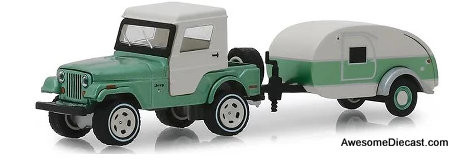


Greenlight
Greenlight 1:64 1972 Jeep CJ-5 And Tear Drop Trailer: Hitch & Tow Series

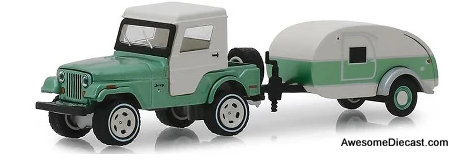
Greenlight 1:64 1972 Jeep CJ-5 And Tear Drop Trailer: Hitch & Tow Series
$263.91
The Jeep CJ models are both a series and a range of small, open-bodied off-road vehicles and compact pickup trucks, built and sold by several successive incarnations of the Jeep automobile marque from 1945 to 1986. The 1945 Willys Jeep was the world's first mass-produced civilian four-wheel drive car.
In 1944, Willys-Overland, one of the two main manufacturers of the World War II military Jeep, built the first prototypes for a commercial version – the CJ, short for "civilian Jeep". From then on, all CJ Jeeps consistently had a separate body and frame, rigid live axles with leaf springs both front and rear, a tapering nose design with flared fenders, and a fold-flat windshield, and could be driven without doors. Also, with few exceptions, they had part-time four-wheel drive systems, with the choice of high and low gearing, and open bodies with removable hard or soft tops.
After remaining in production through a range of model numbers, and several corporate parents, the Jeep CJ line was officially ended in 1986. More than 1.5 million CJ Jeeps were built, having continued the same basic body style for 45 years since the Jeep first appeared. Widely regarded as "America's workhorse", the CJs have been described as "probably the most successful utility vehicle ever made." American Motors VP Joseph Cappy said the end of "CJ production will signal an end of a very important era in Jeep history." The Jeep CJ-7 was replaced in 1986 by the similar-looking Jeep Wrangler. The Jeep CJ-8 and CJ-10s were succeeded by the Jeep Comanche pickup.
The similar model, the DJ "Dispatcher" was introduced in 1956 as a two-wheel drive version with open, fabric, or a closed steel body in both left- and right-hand drives for hotel, resort, police, and later United States Postal Service markets.The Willys CJ-5 (after 1964 Jeep CJ-5) was influenced by new corporate owner, Kaiser, and the Korean War M38A1 Jeep. It was intended to replace the CJ-3B, but that model continued in production. The CJ-5 repeated this pattern, continuing in production for three decades while three newer models appeared. "The CJ-5 has the distinct honor of being a vehicle that was hard to kill off... equaling the longest production run of note
From 1961 to 1965, optional for the CJ-5 and CJ-6 was the British-made Perkins 192 cu in (3.15 L) Diesel I4 with 62 hp (46 kW) at 3,000 rpm and 143 lb/ft (213 kg/m) at 1350 rpm.
In 1965, Kaiser bought license to produce the Buick 225 cu in (3.7 L) V6 Dauntless engine, to offer the new 155 hp (116 kW) option on the CJ-5 and CJ-6, countering complaints that the 75 hp four-cylinder Willys Hurricane engine was underpowered. Power steering was a $81 option. The V6 engine proved so popular, by 1968, some 75% of CJ-5s were sold with it
Kaiser Jeep was sold to American Motors Corporation (AMC) in 1970, and the Buick engine was retired after the 1971 model year. (GM's Buick division repurchased the engine tooling in the early 1970s which served as the powerplant in several GM vehicles.) The "Trac-Lok" limited-slip differential replaced the "Powr-Lok" in 1971, and PTOs were no longer available after that year. AMC began marketing the Jeep less as a universal utility vehicle, and more as a sporty one, notably increasing its performance and features.
A teardrop trailer, also known as a teardrop camper trailer, is a streamlined, compact, lightweight travel trailer, which gets its name from its teardrop profile. They usually only have sleeping space for two adults and often have a basic kitchen in the rear.
Teardrop trailers first became popular in the 1930s, when magazines such as Mechanix Illustrated published plans. The first teardrop designs incorporated standard 4 by 8-foot sheets of plywood with hardwood spars. Teardrop trailers remained popular until the mid-1960s, after which they disappeared from mainstream camping. However, in the late 1990s, plans became available on the Internet and in recent years teardrop trailers have made a resurgence and are again growing in popularity.
A teardrop trailer is generally small, ranging from 4 feet (1.2 m) to 6 feet (1.8 m) in width and 8 feet (2.4 m) to 10 feet (3.0 m) in length. They are usually 4 feet (1.2 m) to 5 feet (1.5 m) in height. Wheels and tires are usually outside the body and are covered by fenders. Since teardrop trailers are so light, usually less than 1,000 pounds (450 kg), just about any vehicle can tow one and fuel consumption is minimally affected.
There is room inside a teardrop trailer for two people to sleep, as well as storage for clothes and other items. Outside, in the rear under a hatch, there is usually a galley for cooking. Teardrop trailers tend to have lighting and other electrical power supplied by a storage battery, although some have mains power hookups like regular travel trailers.
Some teardrop trailer owners participate in organized camping events for teardrop trailers, called "gatherings". The teardrop trailer phenomenon is not local to any one country. Builders reside throughout the Americas, Europe, Israel, South Africa, New Zealand and Australia. In Australia they are known as teardrop campers. Their popularity has resulted in the establishment of several commercial manufacturing organizations and in the import of some North American models.