








Hachette
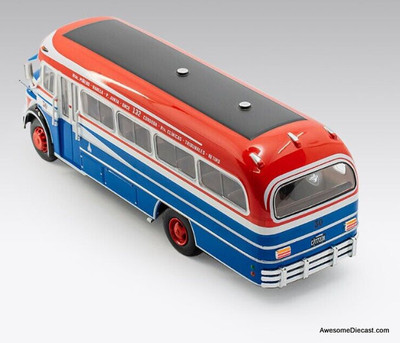
Hachette 1:43 1970 Mercedes Benz LO 1114: Argentina Bus Line 132
This model is sold in a blister pack



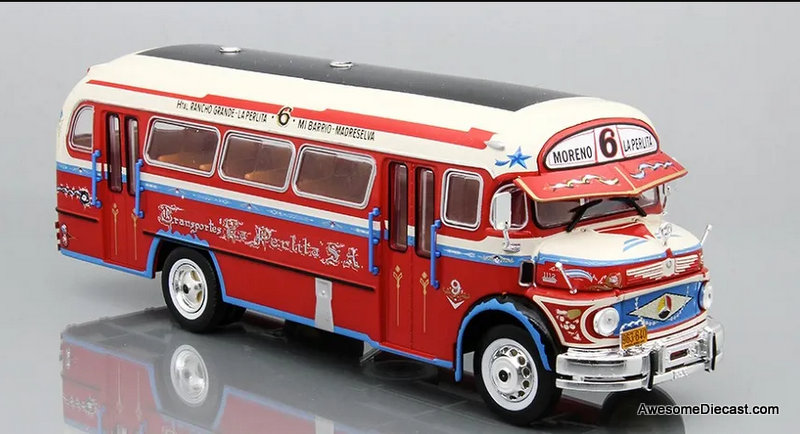
This model is sold in a blister pack
Mercedes-Benz has been producing buses since 1895 in Mannheim in Germany. Since 1995, the brand of Mercedes-Benz buses and coaches is under the umbrella of EvoBus GmbH, belonging 100% to the Daimler AG
The world's first motorised bus was built in Germany by Karl Benz in 1895, some years before Gottlieb Daimler also started to build and sell buses in Germany as well. By 1898 both Karl Benz and Gottlieb Daimler, then rivals, were exporting their buses to Wales and England. Soon Daimler products were sold in the British Empire in a partnership with the British company Milnes. Milnes-Daimler developed a double-decker in 1902 and provided a bus for the first motorised bus service in the United Kingdom the following year. Though the company met success in selling buses throughout the British Empire, the partnership between Daimler and Milnes had to be undone due to the First World War.
Due to economic hardships in the early 1900s, Daimler Motoren Gesellschaft and Benz & Cie. merged into one company in 1926, two years after both companies signed an agreement of mutual interest. Thus, Daimler-Benz AG (also known as Mercedes-Benz) was formed. In the next year, the company presented its first combined bus range. By that time emphasis was given to diesel engines (as opposed to petrol engines) for commercial vehicles.
In 1951 Mercedes-Benz unveiled its first bus specifically designed for bus operation (and not derived from a lorry, as was the case of the other buses produced by the company until then) – the O6600 H. This 11-metre-long vehicle was equipped with a six-cylinder, transverse-mounted rear engine delivering 145 hp, a lower frame than its predecessors, and an electric gearshift system.
In 1954 Mercedes-Benz unveiled its first semi-integral bus – the O321 H. The semi-integral design meant a reduction in weight, improvements in stability and body resistance. The O321 H also was the first to feature coil springs in the front-axle suspension. This 9.2-metre-long vehicle (a 10.9-metre version was later unveiled) also featured a rear-mounted engine. The first version was available with an output of 110 hp, and a later optional 126-hp version was made available. More than 30,000 units of the O321 H complete bus and its platform were sold around the world, a mark which places it as the best-selling bus of its time and, until today, one of the most successful models by Mercedes-Benz.
In 1951 the then Daimler-Benz AG set up in Argentina its first factories outside Germany, one in the town of San Martín, near Buenos Aires, and another in González Catán on industrial suburbs. The San Martin plant was closed at the end of the 1950s.
Mercedes-Benz released updated local colectivo based on modified L 3500 truck chassis – LO3500, OP3500, LO311, LO312– with a separately manufactured body fitted at a later stage by different coach builders. Also, it is important to note that the LO312 was the first Mercedes-Benz bus front chassis manufactured in Argentina
In 1963 Mercedes built the 10,000th colectivo (model LO312), and continued with other models, such as LO1112, (120 HP), LA1112 4x4 (traction in all wheels) and the LO1114. Due to the family relationship with the truck, the Mercedes-Benz colectivos had a diesel engine with power transmitted to the rear axle by a five-speed constant-mesh gearbox.
Perlite SAT is a company Collective covering part of the western area of the Great Buenos Aires , being the only company to provide municipal tours matches Moreno and General Rodriguez
On October 23, 1963, a group of drivers from a provincial line that passed around the Moreno district decided to unite and create Transportes La Perlita SRL. The first route was traced between the Moreno Station and the La Perlita neighborhood (Short for the name of the daughter of the owner of the parcel land that gave rise to the neighborhood and from which the company took its name), obtaining the municipal concession (Line) No. 6 A year later the company was adding new components (partners) that began to expand as the neighborhoods urbanized.
In 1969, as part of the process of reorganization of concessions, line 6 was split into lines 501 (of municipal concession) and 311 , the latter of provincial concession, since this branch reached the Barrio Santa Brígida of the then Partido de General Sarmiento (today San Miguel Party ).
Hachette
This model is sold in a blister pack
Matrix
This highly detailed resin model is a limited edition with only 408 pieces distributed world wide

