




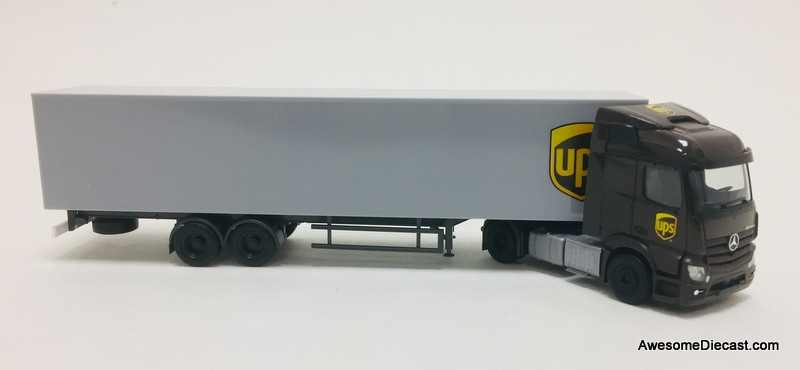
Herpa 1;87 scale UPS tractor trailer
Great built but, a little too high on the price side even when it is built in W. Germany

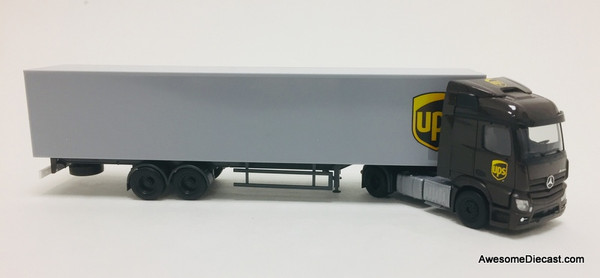


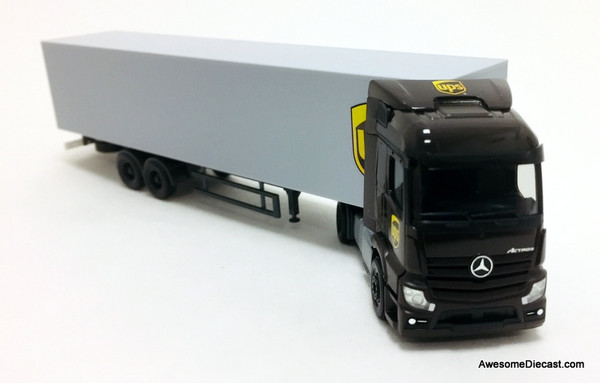

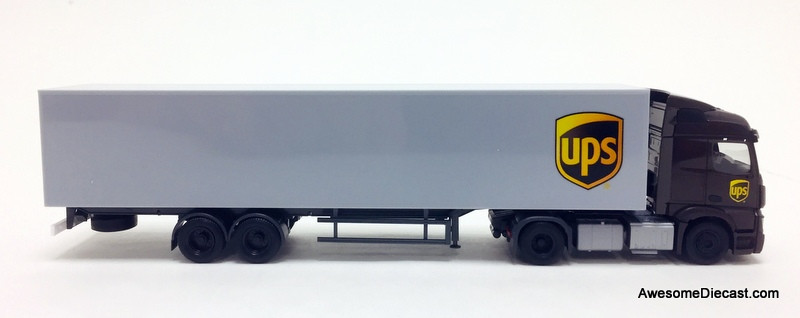


The Mercedes-Benz Actros is a heavy-duty truck introduced by Mercedes-Benz in 1996. It is normally used for long-distance haulage, heavy duty distribution haulage and construction haulage. It is available in weights starting at 18 tonnes and is powered by an inline-6 diesel engine with turbocharger and intercooler. Daimler Trucks/Lorries launched the version II of the Actros in 2002, and the version III in 2008. The fourth generation of the Actros, named officially "the New Actros", launched in July 2011.
The Mercedes Benz Actros is equipped with two types of engines. The OM 501 LA-541 and the OM 502 LA-542. The OM 501 is a 12-litre V6, and has outputs ranging from 310 HP to 480 HP. The engine management system employed by this engine is the PLD (Pumpe Leitung Duese-German abbr) which incorporates single plug-in pumps for each cylinder supplying fuel under pressure (up to 1,600 bar) to the injection valves. A control unit MR monitors all engine operating conditions via several sensors and varies the injection pressure to suit each operating condition.#OM502 is a v8 engine, has an output ranging from 350 HP to 652 HP.
The fourth version offers several engine options in either Euro-5 or Euro-6 compliant models, with various power output.
The second Actros generation comes with an electronic sequential gearbox that Mercedes-Benz has dubbed the "Telligent Gearbox". It pushes forward the principle used in some earlier Mercedes-Benz tractors; using the gearshift lever to command a pneumatically actuated system that changes the gears. The Telligent gearbox utilizes a computer, together with a load-sensing system on the fifth-wheel coupling, to estimate the proper gear that the truck must be in. For example, if you want to upshift, the computer estimates the load on the tractor and the current engine mode, and gives you the proper gear for decreasing engine RPM. On the other hand, if you want to downshift, the computer assumes you wish to overtake, and gives you a proper gear for acceleration.
There's an automatic version which works like the Tiptronic system found in Mercedes-Benz cars.
The fourth-version launched in 2011 offers exclusively the 12-speed powershift transmission.
The system consists of a small lever mounted under the right armrest and a flat switch underneath. The lever is slightly tilted, so that it matches the natural curve of the driver's hand when it's on the armrest. The lever has two buttons on either side. When at a standstill, the driver must push the right button, then (while holding it), push the lever forward and release it select fourth fast. The current gear is shown as a large number on the main display. After doing this, the driver steps on the clutch pedal and waits for approximately two seconds. After the gearshift has completed, a double click is sounded through the speakers, and the driver proceeds with pulling off as normal.
Once moving, the driver has two choices. He or she may push or pull the lever to let the computer choose the gear for them, or they can use the splitter switch (the small switch under the lever) to pre-select gears. Either way, the gear is selected first, then the clutch is depressed. For example, if you're in fourth fast, pulling the splitter switch up once pre-selects fifth slow.
The left button (known as the 'flush button', as it is flush with the lever) is used to switch to neutral.
United Parcel Service (UPS) is an American multinational package delivery and supply chain management company.
Along with the central package delivery operation, the UPS brand name (in a fashion similar to that of competitor FedEx) is used to denote many of its divisions and subsidiaries, including its cargo airline (UPS Airlines), freight-based trucking operation (UPS Freight, formerly Overnite Transportation), and retail-based packing and shipping centers (The UPS Store). The global logistics company is headquartered in the U.S. city of Sandy Springs, Georgia, which is a part of the Greater Atlanta metropolitan area.
On August 28, 1907, James Casey founded the American Messenger Company with Claude Ryan in Seattle, Washington, capitalized with $100 in debt. Most deliveries at this time were made on foot and bicycles were used for longer trips.
The American Messenger Company focused primarily on package delivery to retail stores with special delivery mail delivered for its largest client the United States Postal Service. In 1913, the company acquired a Model T Ford as its first delivery vehicle. Casey and Ryan merged with a competitor, Evert McCabe, and formed Merchants Parcel Delivery. Consolidated delivery was also introduced, combining packages addressed to a certain neighborhood onto one delivery vehicle. In 1916, Charlie Soderstrom joined Merchants Parcel Delivery bringing in more vehicles for the growing delivery business. In 1919, the company expanded for the first time outside of Seattle to Oakland, California and changed its name to United Parcel Service. The name change to United Parcel Service was to remind the company expansion that operations were still United under the same organisation and Parcel identified the type of business offered as part of its Service. Common carrier service was acquired in 1922 from a company in Los Angeles, California. UPS became one of the only companies in the United States to offer common carrier service. At first common carrier was only limited to a small area around Los Angeles but by 1927 expanded to areas up to 125 miles outside the city. In 1924, a conveyor belt system was debuted for the handling of packages for UPS operations.
In 1930, a consolidated service began in New York City, and soon after in other major cities in the East and the Midwest. The use of common carrier for delivery between all customers placed UPS in direct competition with the United States Postal Service and the Interstate Commerce Commission. The common carrier service was applied in cities where UPS could use the service without the authority of the ICC and state commerce commissions. The first city for UPS to use common carrier status outside California was Chicago, Illinois in 1953.
Air service through UPS was first used in 1929 through private airlines. However, The Great Depression and a lack of volume ended the air service. In 1953, UPS resumed air service called UPS Blue Label Air with two-day service to major cities along the East Coast and West Coast.