








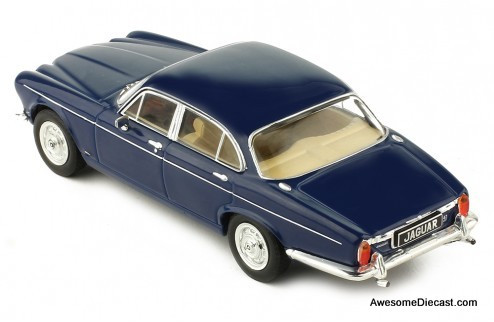
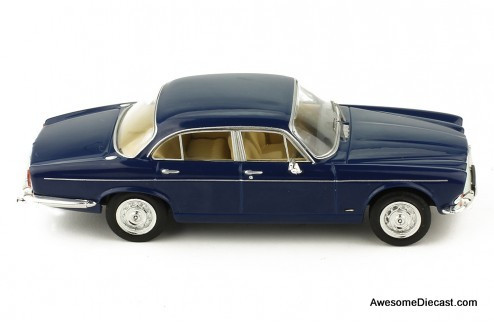


IXO 1:43 1972 Jaguar XJ MK1 RHD, Blue
£26.02
The first-generation of the XJ was produced for a total period of 24 years, with two major facelifts in 1973 and 1979.
The XJ6, using the 2.8-litre (2,792 cc (170.4 cu in)) and 4.2-litre (4,235 cc (258.4 cu in)) straight-six cylinder versions of Jaguar's renowned XK engine, replaced most of Jaguar's saloons – which, in the 1960s, had expanded to four separate ranges. Apart from the engines, the front and rear suspensions carried over from previous models as well: the widest version of Jaguar's IRS unit from the Mark X, and the subframe-mounted independent front suspension first seen in the 1955 Mark 1, with new anti-dive geometry.
An upmarket version was marketed under the Daimler brand as the Daimler Sovereign, continuing the name from the Daimler version of the Jaguar 420.
The car was introduced in September 1968. Power-assisted steering and leather upholstery were standard on the 2.8 L De Luxe and 4.2 L models. Air conditioning was offered as an optional extra on the 4.2 L Daimler versions, which were launched in October 1969 in a series of television advertisements featuring Sir William. In these advertisements, he referred to the car as "the finest Jaguar ever". An unusual feature inherited from the Mark X and S-Type saloons was the twin fuel tanks, positioned on each side of the boot / trunk, and filled using two separately lockable filler caps: one on the top of each wing above the rear wheel arches. Preliminary reviews of the car were favourable, noting the effective brakes and good ride quality.
In March 1970 it was announced that the Borg-Warner Model 8 automatic transmission, which the XJ6 had featured since 1968, would be replaced on the 4.2-litre XJ6 with the Borg-Warner Model 12.The new transmission had three different forward positions accessed via the selector lever, which effectively enabled performance oriented drivers to hold lower ratios at higher revs to achieve better acceleration. "Greatly improved shift quality" was also claimed for the new system.
Around this time other, minor changes were made as well, such as moving the rear reflectors from beside to below the rear lights; on the interior the chrome gauge bezels were replaced with black ones, to cut down on distracting reflections.
In 1972, the option of a long-wheelbase version, providing a 4-inch increase in leg room for passengers on the rear seats, became available.
A high performance version called the XJ12 was announced in July 1972, featuring a simplified grille treatment, and powered by a Jaguar's 5.3 L V12 engine coupled to the Borg-Warner Model 12 transmission. At the time it was the only mass-produced 12-cylinder, four-door car in the world and, with a top speed of "around" 225 km/h (140 mph), it was the "fastest full four-seater available in the world". Although it had been the manufacturer's intention from launch that the XJ would use the 12-cylinder engine its installation was nonetheless a tight fit, and providing adequate cooling had been a challenge for Jaguar's engineers. Bonnet/hood louvres such as those fitted on the 12-cylinder E Type were rejected and instead the XJ12 featured a complex "cross-flow" radiator divided into two separated horizontal sections supported with coolant feeder tanks at each end. The engine fan was geared to rotate at 1¼ times the speed of the engine, subject to a limiter which cut in at a fan speed of 1,700 rpm. The fuel system incorporated a relief valve that returned fuel to the tank when pressure in the lines to the carburettors exceeded 1.5 psi, to reduce the risk of vapour locks occurring at the high operating temperatures, while the car's battery had its own thermostatically-controlled cooling fan.