







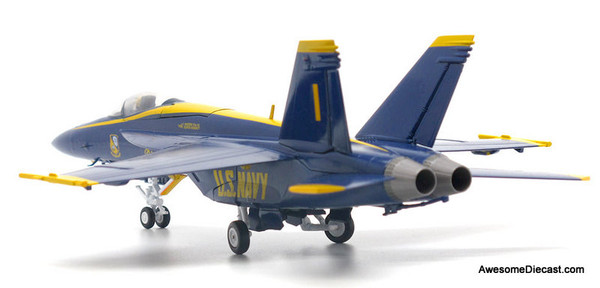
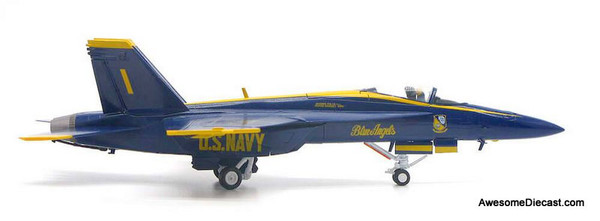


JC Wings 1:72 2021 Boeing F/A-18E Super Hornet: US Navy Blue Angels


JC Wings 1:72 2021 Boeing F/A-18E Super Hornet: US Navy Blue Angels
$97.57
The Boeing F/A-18E and F/A-18F Super Hornet are twin-engine, carrier-capable, multirole fighter aircraft variants based on the McDonnell Douglas F/A-18 Hornet. The F/A-18E single-seat and F/A-18F tandem-seat variants are larger and more advanced derivatives of the F/A-18C and D Hornet.
The Super Hornet has an internal 20 mm M61 rotary cannon and can carry air-to-air missiles and air-to-surface weapons. Additional fuel can be carried in up to five external fuel tanks and the aircraft can be configured as an airborne tanker by adding an external air-to-air refueling system.
Designed and initially produced by McDonnell Douglas, the Super Hornet first flew in 1995. Low-rate production began in early 1997 with full-rate production starting in September 1997, after the merger of McDonnell Douglas and Boeing the previous month. The Super Hornet entered fleet service with the United States Navy in 1999, replacing the Grumman F-14 Tomcat, which was retired in 2006; the Super Hornet has served alongside the original Hornet. The Royal Australian Air Force (RAAF), which has operated the F/A-18A as its main fighter since 1984, ordered the F/A-18F in 2007 to replace its aging General Dynamics F-111C fleet. RAAF Super Hornets entered service in December 2010.
The Blue Angels is a flight demonstration squadron of the United States Navy. Formed in 1946, the unit is the second oldest formal aerobatic team (under the same name) in the world, after the French Patrouille de France formed in 1931. The team, composed of five Navy and one Marine Corps demonstration pilot, fly Boeing F/A-18 Super Hornets.
The Blue Angels typically perform aerial displays in at least 60 shows annually at 30 locations throughout the United States and two shows at one location in Canada. The "Blues" still employ many of the same practices and techniques used in the inaugural 1946 season. An estimated 11 million spectators view the squadron during air shows from March through November each year. Members of the Blue Angels team also visit more than 50,000 people in schools, hospitals, and community functions at air show cities. Since 1946, the Blue Angels have flown for more than 505 million spectators.
As of November 2011, the Blue Angels received $37 million annually out of the annual Department of Defense budget.