








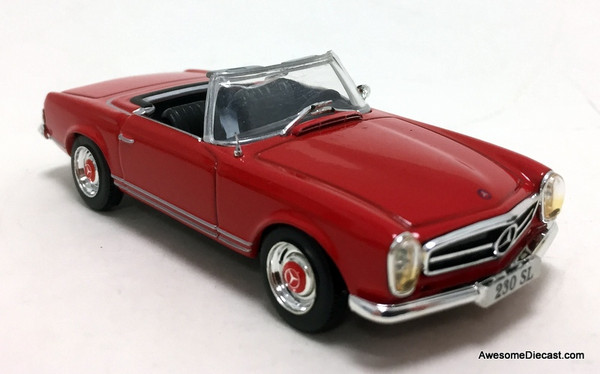
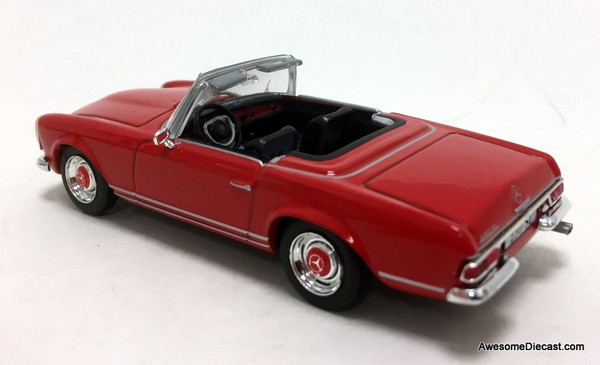
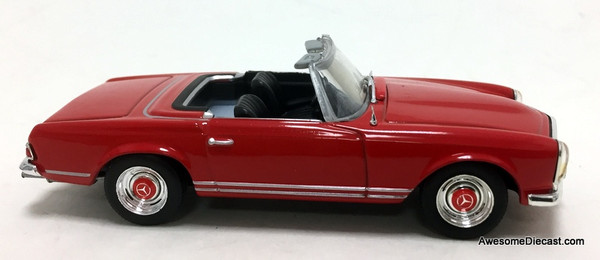
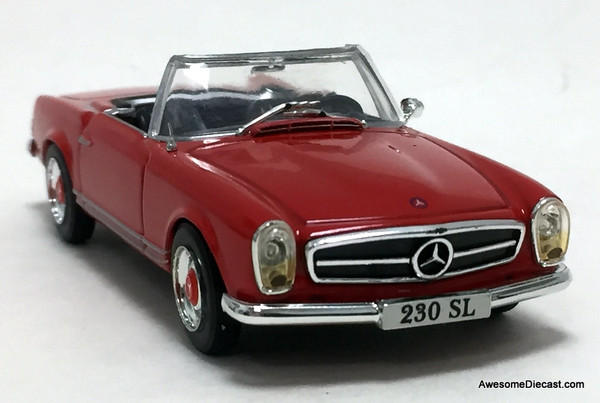


Last One!! DeAgostini 1:43 1963 Mercedes Benz 230 SL Convertible
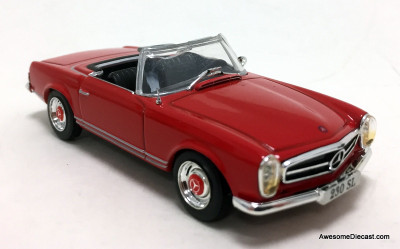
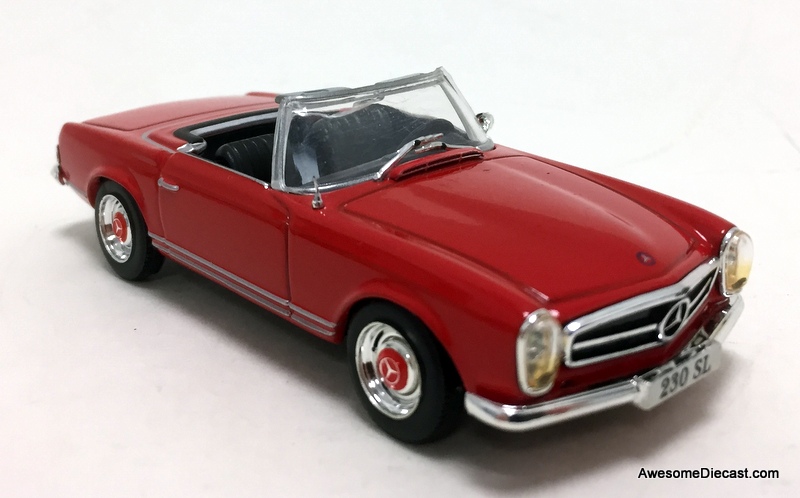
Last One!! DeAgostini 1:43 1963 Mercedes Benz 230 SL Convertible
$57.66
This is the last model in stock and it has a slight crack in case
The Mercedes-Benz W 113 is a two-seat roadster/coupé, introduced at the 1963 Geneva Motor Show, and produced from 1963 through 1971. It replaced both the 300 SL (W 198) and the 190 SL (W 121 BII). Of the 48,912 W 113 SLs produced, 19,440 were sold in the US.
The W 113 SL was developed under the auspices of Mercedes-Benz Technical Director Fritz Nallinger, Chief Engineer Rudolf Uhlenhaut and Head of Styling Friedrich Geiger. The lead designers were Paul Bracq and Béla Barényi, who created its patented, slightly concave hardtop, which inspired the "Pagoda" nickname.
All models were equipped with an inline-six cylinder engine with multi-port fuel injection. The bonnet, boot lid, door skins and tonneau cover were made of aluminum to reduce weight. The comparatively short and wide chassis, combined with an excellent suspension, powerful brakes and radial tires gave the W 113 superb handling for its time. The styling of the front, with its characteristic upright Bosch "fishbowl" headlights and simple chrome grille, dominated by the large three-pointed star in the nose panel, paid homage to the 300 SL roadster.
W 113 SLs were typically configured as a "Coupe/Roadster" with a soft-top and an optional removable hardtop. A 2+2 was introduced with the 250 SL "California Coupe," which had a fold-down rear bench seat instead of the soft-top.
By 1955, Mercedes-Benz Technical Director Prof. Fritz Nallinger and his team held no illusions regarding the 190 SL's lack of performance, while the high price tag of the legendary 300 SL supercar kept it elusive for all but the most affluent buyers. Thus Mercedes-Benz started evolving the 190 SL on a new platform, model code W127, with a fuel-injected 2.2 liter M127 inline-six engine, internally denoted as 220SL. Encouraged by positive test results, Nallinger proposed that the 220SL be placed in the Mercedes-Benz program, with production commencing in July 1957.
However, while technical difficulties kept postponing the production start of the W127, the emerging new S-Class W 112 platform introduced novel body manufacturing technology altogether. So in 1960, Nallinger eventually proposed to develop a completely new 220SL design, based on the "fintail" W 111 sedan platform with its chassis shortened by 30 cm (11.8 in), and technology from the W 112. This led to the W 113 platform, with an improved fuel-injected 2.3 liter M127 inline-six engine and the distinctive "pagoda" hardtop roof, designated as 230 SL.
The 230 SL made its debut at the Geneva Motor Show in March 1963, where Nallinger introduced it as follows: "It was our aim to create a very safe and fast sports car with high performance, which despite its sports characteristics, provides a very high degree of traveling comfort".
Production of the 230 SL commenced in June 1963 and ended on 5 January 1967. Its chassis was based on the W 111 sedan platform, with a reduced wheelbase by 30 cm (11.8 in), recirculating ball steering (with optional power steering), double wishbone front suspension and an independent single-joint, low-pivot swing rear-axle with transverse compensator spring. The dual-circuit brake system had front disc brakes and power-assisted rear drum brakes. The 230 SL was offered with a 4-speed manual transmission, or an optional, very responsive fluid coupled (no torque converter) 4-speed automatic transmission, which was popular for US models. From May 1966, the ZF S5-20 5-speed manual transmission was available as an additional option, which was particularly popular in Italy. Of the 19,831 230 SLs produced, less than a quarter were sold in the US.
The 2,308 cc (2.3 L) M127.II inline-six engine with 150 PS (110 kW; 148 hp) and 196 N⋅m (145 lb⋅ft) torque was based on Mercedes-Benz' venerable M180 inline-six with four main bearings and mechanical Bosch multi-port fuel injection. Mercedes-Benz made a number of modifications to boost its power, including increasing displacement from 2,197 cc (2.2 L), and using a completely new cylinder head with a higher compression ratio (9.3 vs. 8.7), enlarged valves and a modified camshaft. A fuel injection pump with six plungers instead of two was fitted, which allowed placing the nozzles in the cylinder head and "shooting" the fuel through the intake manifold and open valves directly into the combustion chambers. An optional oil-water heat exchanger was also available.

