









Oxford Diecast
Oxford 1:43 1971 Land Rover Series 11A SWB, Green

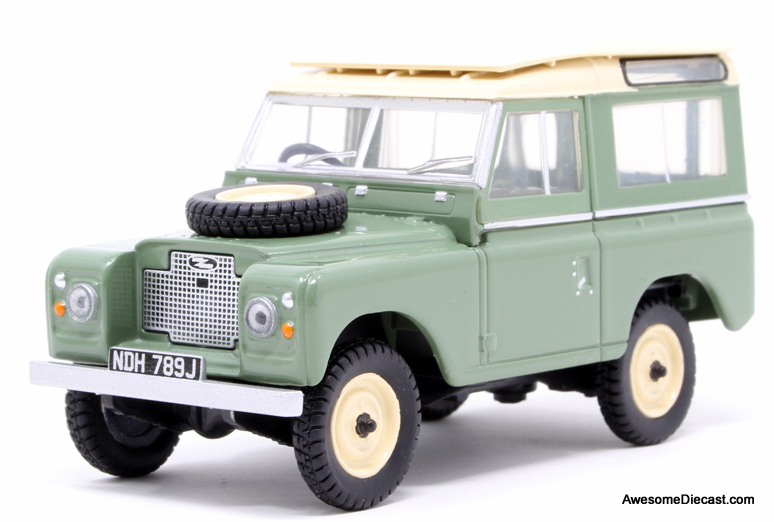
Oxford 1:43 1971 Land Rover Series 11A SWB, Green
£22.43
The Land Rover series I, II, and III (commonly referred to as series Land Rovers, to distinguish them from later models) are off-road vehicles produced by the British manufacturer Rover Company. The Land Rover was the first mass-produced civilian four-wheel drive car with doors on it. In 1992, Land Rover claimed that 70% of all the vehicles they had built were still in use.
Most series models feature leaf-sprung suspension with selectable two or four-wheel drive (4WD), however series I's produced between 1948 and mid-1951 had constant 4WD via a freewheel mechanism, and the Stage 1 V8 version of the series III featured permanent 4WD. All three models could be started with a front hand crank and had the option of front & rear power takeoffs for accessories.
The Land Rover was conceived by the Rover Company in 1947 during the aftermath of World War II. Before the war Rover had produced luxury cars which were not in demand in the immediate post-war period and raw materials were strictly rationed to those companies building construction or industrial equipment, or products that could be widely exported to earn crucial foreign exchange for the country. Also, Rover's original factory in Coventry had been bombed during the war, forcing the company to move into a huge "shadow factory" built just before the war in Solihull near Birmingham, previously used to construct Bristol Hercules aircraft engines. This factory was now empty but starting car production there from scratch would not be financially viable. Plans for a small, economical car known as the M Type were drawn up, and a few prototypes made, but would be too expensive to produce.
Maurice Wilks, Rover's chief designer came up with a plan to produce a light agricultural and utility vehicle, of a similar concept to the Willys Jeep used in the war, but with an emphasis on agricultural use. He was possibly inspired by the Standard Motor Company, who faced similar problems and were producing the highly successful Ferguson TE20 tractor in their shadow factory in Coventry. More likely, he used his own experience of using an army-surplus Jeep on his farm in Anglesey, North Wales. His design added a power take-off (PTO) feature since there was a gap in the market between jeeps and tractors (which offered the feature but were less flexible as transport). The original Land Rover concept (a cross between a light truck and a tractor) is similar to the Unimog, which was developed in Germany during this period.
The first prototype had a distinctive feature — the steering wheel was mounted in the middle of the vehicle. It hence became known as the "centre steer". It was built on a Jeep chassis and used the engine and gearbox out of a Rover P3 saloon car. The bodywork was handmade out of an aluminium/magnesium alloy called Birmabright, to save on steel, which was closely rationed. The choice of colour was dictated by military surplus supplies of aircraft cockpit paint, so early vehicles only came in various shades of light green. The first pre-production Land Rovers were being developed in late 1947 by a team led by engineer Arthur Goddard.
Tests showed this prototype vehicle to be a capable and versatile machine. The PTO drives from the front of the engine and from the gearbox to the centre and rear of the vehicle allowed it to drive farm machinery, exactly as a tractor would. It was also tested ploughing and performing other agricultural tasks. However, as the vehicle was readied for production, this emphasis on tractor-like usage decreased and the centre steering proved impractical in use. The steering wheel was mounted off to the side as normal, the bodywork was simplified to reduce production time and costs and a larger engine was fitted, together with a specially designed transfer gearbox to replace the Jeep unit. The result was a vehicle that didn't use a single Jeep component and was slightly shorter than its American inspiration, but wider, heavier, faster and still retained the PTO drives.
The Land Rover was designed to only be in production for two or three years to gain some cash flow and export orders for the Rover Company so it could restart up-market car production. Once car production restarted, however, it was greatly outsold by the off-road Land Rover, which developed into its own brand that remains successful today. Many of the defining and successful features of the Land Rover design were in fact the result of Rover's drive to simplify the tooling required for the vehicle and to use the minimum amount of rationed materials. As well as the aluminium alloy bodywork (which has been retained throughout production despite it now being more expensive than a conventional steel body due to its ideal properties of light weight and corrosion resistance) other examples include the distinctive flat body panels with only simple, constant-radius curves (originally used because they could be cut and formed by hand from aluminium sheet on a basic jig) and the sturdy box-section ladder chassis, which on series vehicles was made up from four strips of steel welded at each side to form a box, thus cutting down on the complex operations required when making a more conventional U- or I-section frame.
The SII and the SIIA are very difficult to distinguish. There were some minor cosmetic changes. Body configurations available from the factory ranged from short-wheelbase soft-top to the top-of-the-line five-door station wagon. A 2.25-litre Diesel was added to the engine line, which after 1967 included a 2.6-litre inline six cylinder petrol engine for the long-wheelbase models, which also had servo-assisted brakes. 811 of these were NADA (or North American Dollar Area) trucks, which were the only long-wheelbase models made for the American and Canadian markets.
From February 1969 (home market), the headlamps moved into the wings on all models, and the sill panels were redesigned to be shallower a few months afterwards.
The series IIA is considered by many the most hardy series model constructed. It is quite possibly also the type of classic Land Rover that features strongly in the general public's perception of the Land Rover, from its many appearances in popular films and television documentaries set in Africa throughout the 1960s, such as Born Free. In February 1968, just a few months after the Rover Company had been subsumed, under government pressure, into the Leyland Motor Corporation, the Land Rover celebrated its twentieth birthday, with total production to date just short of 600,000, of which more than 70% had been exported. Certainly it was whilst the series IIA was in production that sales of utility Land Rovers reached their peak, in 1969–70, when sales of over 60,000 Land Rovers a year were recorded. (For comparison, the sales of the Defender have been around the 25,000 level since the 1990s.) As well as record sales, the Land Rover dominated many world markets- in Australia in the 1960s Land Rover held 90% of the 4×4 market. This figure was repeated in many countries in Africa and the Middle East.