








Oxford Diecast
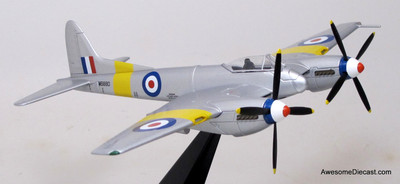
Oxford Diecast 1:72 DH. 103 Hornet - Royal Air Force
Made from metal and resin diecast.



The de Havilland DH.104 Dove is a British short-haul airliner developed and manufactured by de Havilland. It was a monoplane successor to the prewar de Havilland Dragon Rapide biplane. The design came about from the Brabazon Committee report which, amongst other aircraft types, called for a British-designed short-haul feeder for airlines.
The Dove was a popular aircraft and is considered to be one of Britain's most successful postwar civil designs, in excess of 500 aircraft being manufactured between 1946 and 1967. Several military variants were operated, such as the Devon by the Royal Air Force, the Sea Devon by the Royal Navy and the type also saw service with a number of overseas military forces.
A longer four-engined development of the Dove, intended for use in the less developed areas of the world, was the de Havilland Heron. A considerably re-designed three-engined variant of the Dove was built in Australia as the de Havilland Australia DHA-3 Drover.
The development team for the Dove was headed by Ronald Eric Bishop, the creator of the de Havilland Mosquito, a wartime fighter-bomber, and the de Havilland Comet, the first commercial jet aircraft in the world. It had been developed to meet the Type VB requirement issued by the Brabazon Committee. In concept, the Dove was developed to be the replacement of the prewar de Havilland Dragon Rapide. It was also required to be competitive with the large numbers of surplus military transports in the aftermath of the Second World War, such as the Douglas DC-3. Unlike the Dragon Rapide, the Dove made use of a structure entirely of metal. It also featured other innovations of the time, including constant-speed propellers, flaps, and a retractable tricycle undercarriage.
In 1946, aviation magazine Flight praised the qualities of the newly developed Dove, noting its "modernity" as well as the aircraft's load-carrying capacity, safe engine-failure performance, and positive maintenance features. Considerable attention was paid to aspects of maintainability, many of the components being designed to be interchangeable and easy to remove or replace, such as the rudder, elevator, and power units; other areas include the mounting of the engines upon four quick-release pickup points, the routing of cables and piping, and detachable wings and tail cone. The extensive use of special Redux metal-bonding adhesives reduced the need for riveting during the manufacturing process, reducing overall weight and air-skin friction.
While standard passenger versions of the Dove would carry between eight and eleven passengers, the cabin was designed to allow operators to convert between higher and lower density seating configurations. Features such as a single aircraft lavatory and an aft luggage compartment could be removed to provide for increased seating capacity. Various specialised models were produced for other roles, such as aerial survey, air ambulance, and flying classroom. A strengthened cabin floor structure was used to enable concentrated freight loads to be carried as well. The Dove could also serve as a dedicated executive transport, and in such a configuration it was capable of seating a total of five passengers; the executive model proved to be popular with various overseas customers, particularly those in the United States.
The crew typically consisted of a pilot and radio operator. However, rapidly removable dual flight controls could be installed for a second flying crewmember instead. A combination of large windows and a transparent perspex cabin roof provided a high level of visibility from the cockpit. From a piloting perspective, the Dove was observed for possessing easy flying qualities and mild stall qualities. A TKS anti-icing system was available for the Dove, involving an alcohol-based jelly delivered via porous metal strips embedded on the leading edges of the wings and tail.
In September 1945, the first Dove conducted its maiden flight; in December 1946, the first in-service flight for Central African Airways took place. Production of the Dove and its variants totalled 542 units, including 127 military-orientated Devons and 13 Sea Devons. The first deliveries to customers took place in Summer 1946, while the final example of the type was delivered in 1967. Initial production of the Dove was performed at de Havilland's Hatfield factory, but from the early 1950s onwards, the majority of aircraft were built at the company's Broughton facility near Chester.
Oxford Diecast
Made from metal and resin diecast.