






Oxford Diecast
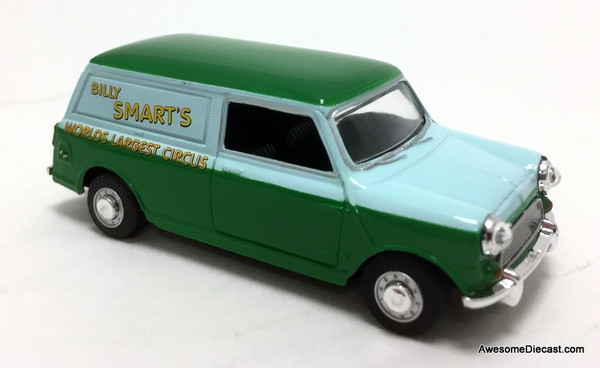
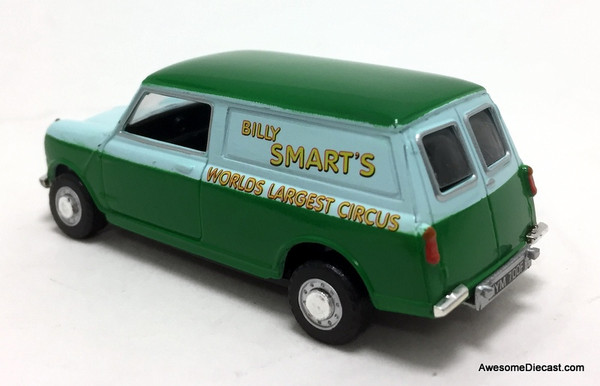
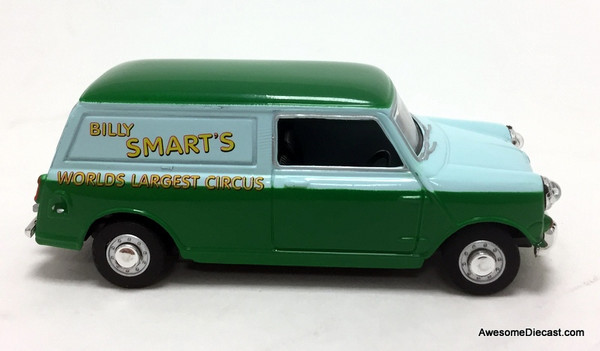
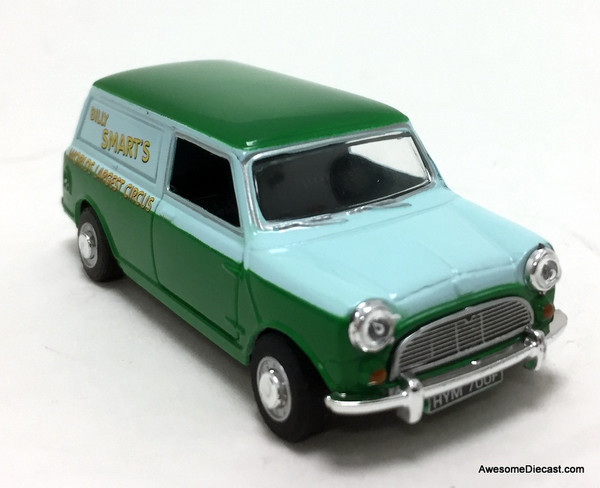
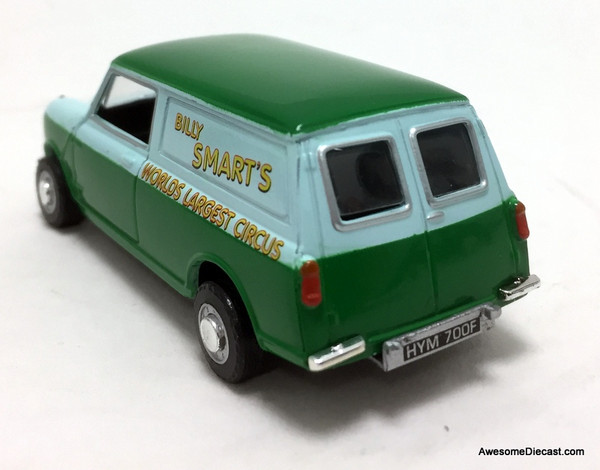
Oxford Diecast 1:43 1968 Austin Mini Van: Billy Smart's Circus
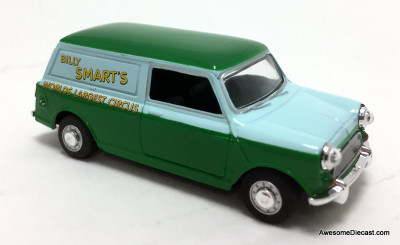

Oxford Diecast 1:43 1968 Austin Mini Van: Billy Smart's Circus
$41.95
The Mini is a small economy car produced by the English-based British Motor Corporation (BMC) and its successors from 1959 until 2000. The original is considered an icon of 1960s British popular culture. Its space-saving transverse engine and front-wheel drive layout – allowing 80% of the area of the car's floorpan to be used for passengers and luggage – influenced a generation of car makers. In 1999, the Mini was voted the second-most influential car of the 20th century, behind the Ford Model T, and ahead of the Citroën DS and Volkswagen Beetle. The front-wheel-drive, transverse-engine layout of the Mini was copied for other "supermini" designs including the Honda N360 (1967), Nissan Cherry (1970), and Fiat 127 (1971). The layout was also adapted for larger subcompact designs.
This distinctive two-door car was designed for BMC by Sir Alec Issigonis. It was manufactured at the Longbridge and Cowley plants in England, the Victoria Park/Zetland British Motor Corporation (Australia) factory in Sydney, Australia, and later also in Spain (Authi), Belgium, Chile, Italy (Innocenti), Malta, Portugal, South Africa, Uruguay, Venezuela, and Yugoslavia. The Mini Mark I had three major UK updates – the Mark II, the Clubman, and the Mark III. Within these was a series of variations, including an estate car, a pick-up truck, a van, and the Mini Moke, a jeep-like buggy.
The performance versions, the Mini Cooper and Cooper "S", were successful as both race and rally cars, winning the Monte Carlo Rally in 1964, 1965, and 1967. In 1966, the first-placed Mini (along with nine other cars) was disqualified after the finish, under a controversial decision that the car's headlights were against the rules.
On its introduction in August 1959, the Mini was marketed under the Austin and Morris names, as the Austin Seven and Morris Mini-Minor. The Austin Seven was renamed Austin Mini in January 1962 and Mini became a marque in its own right in 1969. In 1980, it once again became the Austin Mini, and in 1988, just "Mini" (although the "Rover" badge was applied on some models exported to Japan).
BMW acquired the Rover Group (formerly British Leyland) in 1994, and sold the greater part of it in 2000, but retained the rights to build cars using the MINI name.
Billy Smart Jr. (born Stanley Smart, 15 October 1934 – 23 May 2005) was a British circus performer and impresario.
Smart, whose real name was Stanley, was the tenth child and third son of Billy Smart Sr. His father was a showman and fairground proprietor, who bought a circus in 1946. He would travel with the Circus and go to local schools when at a location for a lengthy period. One school was 'All Saints' at Blackheath, London in 1958, the heath being a popular location for the circus. The first appearance of the Billy Smart circus was on 5 April at Southall Park in Middlesex. The circus toured alongside Smart's funfair; the tents blew down and the circus carried out its performances for two days in the open air. Smart made his circus debut with "Billy Smart's New World Circus" as assistant ringmaster aged 12. He was soon performing with ponies and horses, but became best known later for his elephant acts. In one famous incident, he tamed a herd of performing elephants when they stampeded in the ring. At its peak, Billy Smart's four-masted Big Top could hold over 6,000 people, with a show including hundreds of animals and performers.
Smart, together with his brothers, Ronald Smart and David Smart, took over management of the circus when their father died in 1966 at Ipswich. The circus ceased touring in 1971, but televised performances continued until 1983, drawing audiences of up to 22 million at its height. The Smart Brothers also developed Guernsey Zoo, selling it in 1972, and opened Windsor Safari Park in 1969 before selling it in 1977, for the equivalent of £30m in 2017 (it is now the site of Legoland Windsor). He lost the sight in his right eye in 1978 after cosmetic surgery severed the optic nerve, ending his career as an animal trainer.
In 1985, the Smart circus Winkfield winter quarters were sold for the equivalent of £20m in 2017.
The "Billy Smart's" touring circus was revived by his brother Ronald and nephew Gary in 1993, but Smart concentrated on a second career as a property developer, based in Spain.
