










Racing Champions
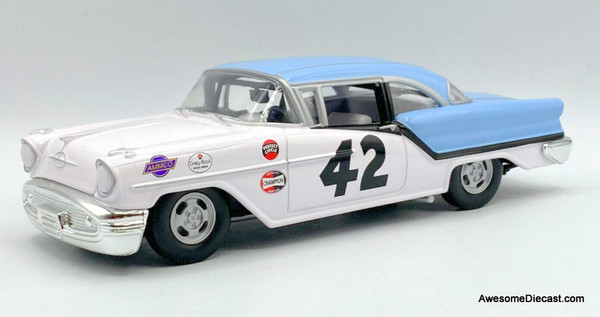
Racing Champions 1:24 1957 Oldsmobile 88: Richard Petty 50th Anniversary Edition

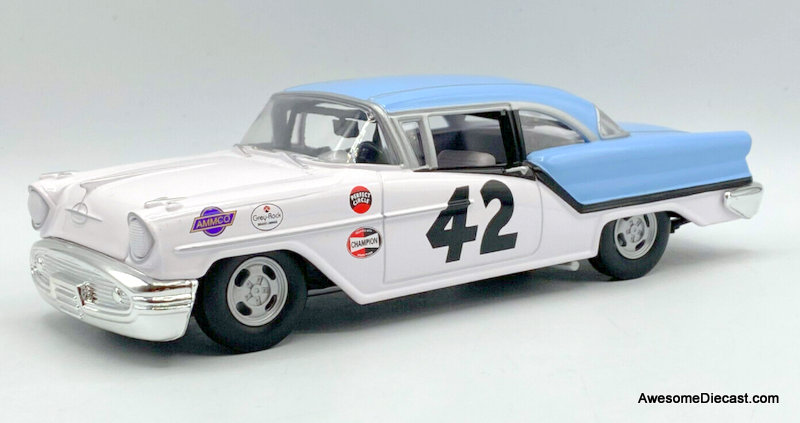
Racing Champions 1:24 1957 Oldsmobile 88: Richard Petty 50th Anniversary Edition
$1,249.52
Richard Lee Petty (born July 2, 1937), nicknamed "The King," is an American former stock car racing driver who raced from 1958 to 1992 in the former NASCAR Grand National and Winston Cup Series (now called the NASCAR Cup Series), most notably driving the No. 43 Plymouth/Pontiac for Petty Enterprises. He was the first driver to win the Cup Series championship seven times (a record now tied with Dale Earnhardt and Jimmie Johnson), while also winning a record 200 races during his career,[1] including the Daytona 500 a record seven times, and a record 27 races (10 of them consecutively) in the 1967 season alone. Statistically, he is the most accomplished driver in the history of the sport, and is one of the most respected figures in motorsports as a whole. Petty remains very active in the sport as both a NASCAR team owner (Richard Petty Motorsports) in the Cup Series, and owner of Petty's Garage (car restoration and modification shop) in Level Cross, North Carolina.
During his 5 decade career, Petty collected a record number of poles (127) and over 700 Top 10 finishes in his record 1,184 starts, including 513 consecutive starts from 1971 to 1989. Petty was the only driver to ever win in his 500th race start, until Matt Kenseth joined him in 2013. He was inducted into the inaugural class of the NASCAR Hall of Fame in 2010. Petty is a second-generation driver. His father, Lee Petty, won the first Daytona 500 in 1959 and was also a three-time NASCAR champion.
For 1957 only, the basic 88 was officially named Golden Rocket 88, taken from Oldsmobile's 1956 Motorama two-passenger show car. However, the only badging was an "88" underneath each taillight. Also for 1957 the "J2" option was offered, with three 2-barrel (0.32 m3) carburetors, similar to the Pontiac Tri-Power. The Super 88 continued as the upscale mid-line series. Under the hood, the Rocket V8 increased in displacement to 371 cubic inches and 277 horsepower (207 kW) for all models across the board. Although rare, three speed manual transmissions were still available. Styling highlights were more evolutional than radical overall with three-piece rear window styling utilized on some models. Oldsmobile revived station wagons for the first time since 1950 with the Super 88 Fiesta being a four-door hardtop design. In 1957, Oldsmobile added a safety deep-recessed steering wheel.
For 1958, GM was promoting their fiftieth year of production, and introduced Anniversary models for each brand; Cadillac, Buick, Oldsmobile, Pontiac, and Chevrolet. The 1958 models shared a common appearance on the top models for each brand; Cadillac Eldorado Seville, Buick Roadmaster Riviera, Oldsmobile Holiday 88, Pontiac Bonneville Catalina, and the all-new Chevrolet Bel-Air Impala.
The 1958 model is best known in Oldsmobile as the year of the "ChromeMobile" thanks to tremendous splatterings of chrome trim on the body, particularly on the higher-priced Super 88 and Ninety-Eight models. The styling was advertised by Olds as the "Mobile Look." The Dynamic 88 debuted in 1958 and lasted through 1966 positioned as the entry level model below the Super 88. This model featured a more economical Rocket V8 than its more expensive linemates – a de-tuned 265 hp (198 kW) version of the 371 cubic-inch Rocket V8 with two-barrel carburation. Super 88 models were powered by a four-barrel 300 hp (220 kW) version of that engine as standard equipment with a J-2 option featuring three two-barrel carburetors and 310 hp (231 kW). A new option for 1958 was a "Trans-Portable" radio that could be removed from the instrument panel through the glove compartment and used as a portable radio for beaches, picnics, etc. thanks to portable batteries. A revised instrument panel was highlighted by a new deep-dish steering wheel with "horn bars" replacing the long-standing horn ring still common during that period.