The Citroën 2CV (French: "deux chevaux" i.e. "deux chevaux-vapeur" (lit. "two steam horses", "two tax horsepower") is an air-cooled front-engine, front-wheel-drive economy car introduced at the 1948 Paris Mondial de l'Automobile and manufactured by Citroën for model years 1948–1990.
Conceived by Citroën Vice-President Pierre Boulanger to help motorise the large number of farmers still using horses and carts in 1930s France, the 2CV has a combination of innovative engineering and utilitarian, straightforward metal bodywork — initially corrugated for added strength without added weight. The 2CV featured low cost, simplicity of overall maintenance, an easily serviced air-cooled engine (originally offering 9 hp), low fuel consumption, and an extremely long-travel suspension offering a soft ride and light off-road capability. Often called "an umbrella on wheels", the fixed-profile convertible bodywork featured a full-width, canvas, roll-back sunroof, which accommodated oversized loads and until 1955 reached almost to the car's rear bumper. Notably, Michelin introduced and first commercialised the radial tyre with the introduction of the 2CV.
Manufactured in France between 1948 and 1988 (and in Portugal from 1988 to 1990), more than 3.8 million 2CVs were produced, along with over 1.2 million small 2CV-based delivery vans known as fourgonnettes. Citroën ultimately offered several mechanically identical variants including the Ami (over 1.8 million); the Dyane (over 1.4 million); the Acadiane (over 250,000); and the Mehari (over 140,000). In total, Citroën manufactured almost 9 million 2CVs and variants.
A 1953 technical review in Autocar described "the extraordinary ingenuity of this design, which is undoubtedly the most original since the Model T Ford". In 2011, The Globe and Mail called it a "car like no other". The motoring writer L. J. K. Setright described the 2CV as "the most intelligent application of minimalism ever to succeed as a car", and a car of "remorseless rationality".
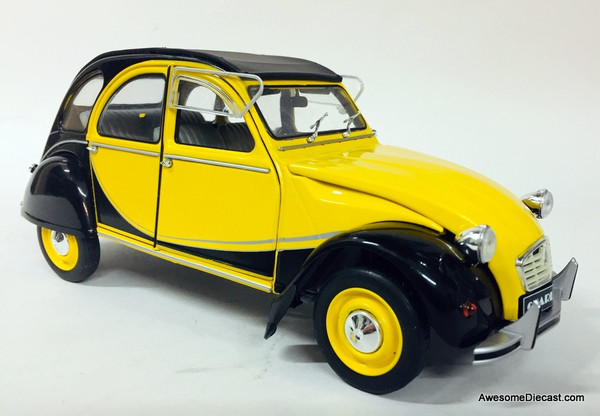
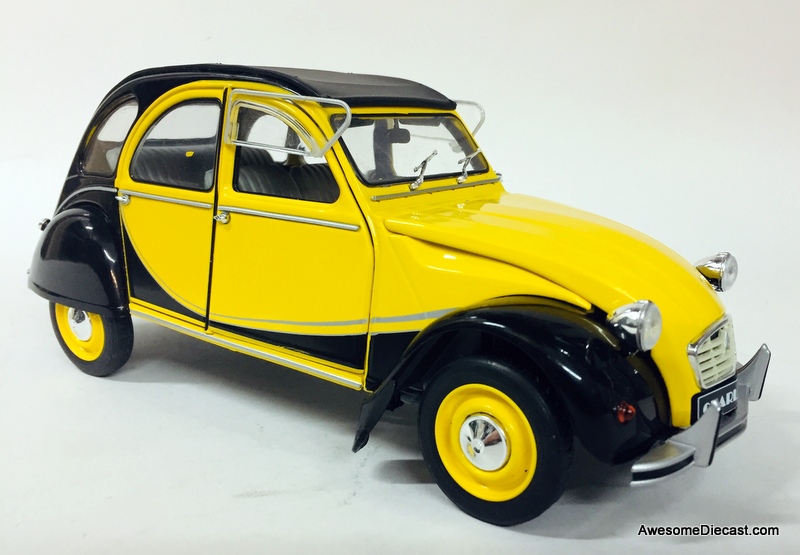
The special edition models began with the 1976 SPOT model and continued in with the 1980 Charleston, inspired by Art-Deco two colour styles 1920s Citroën model colour schemes (initially Grey/Black, Maroon/Black and Yellow/Black). In 1981 the 007 arrived. In 1983 the 2CV Beachcomber arrived in the United Kingdom; it was known as "France 3" in France or "Transat" in other continental European markets—Citroën sponsored the French America's Cup yacht entry of that year. In 1986 there was the Cocorico. This means "cock-a-doodle-doo" and tied in with France's entry in the 1986 World Cup. "Le Coq Gaulois" or Gallic rooster is an unofficial national symbol of France. In 1987 came the Bamboo, followed by the 1988 Perrier in association with the mineral water company.
The Charleston, having been presented in October 1980 as a one-season "special edition" was incorporated into the regular range in July 1981 in response to its "extraordinary success". By changing the carburetor to achieve 29 hp (22 kW), a top speed of 115 km/h (71 mph) was achieved. Other changes were a new rear-view mirror and inboard disc brakes at the front wheels.