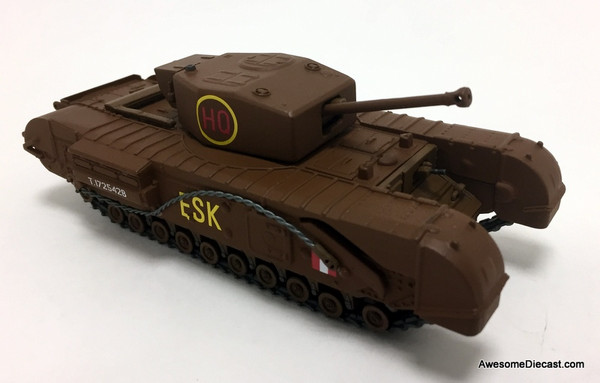
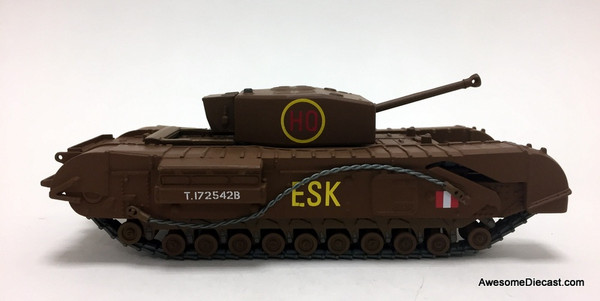
The Tank, Infantry, Mk IV (A22) Churchill was a British heavy infantry tank used in the Second World War, best known for its heavy armour, large longitudinal chassis with all-around tracks with multiple bogies, its ability to climb steep slopes, and its use as the basis of many specialist vehicles. It was one of the heaviest Allied tanks of the war.
The origins of the design lay in the expectation that war in Europe might be fought in conditions similar to those of the First World War and emphasised the ability to cross difficult ground. The Churchill was rushed into production to build up British defences against a possible German invasion. The first vehicles had flaws that had to be overcome before the Churchill was accepted for wide use. After several marks had been built, a better-armoured version, the Mark VII, entered service. The improved versions performed well in the later stages of the war.
The Churchill was used by British and other Commonwealth forces during the North African, Italian and North-West Europe campaigns. In addition, 344 Churchills were sent as military aid to the Soviet Union during the Second World War and more than 250 saw active service on the Eastern Front.
The Churchill tank was named after Prime Minister Winston Churchill, who had promoted the development of the tank in the First World War. Churchill told Field Marshal Jan Smuts "That is the tank they named after me when they found out it was no damn good!"
The name only incidentally matched what became the British Army practice of giving service names beginning with C to cruiser tanks, such as the Covenanter, Crusader, and the later Cromwell, Cavalier and Comet. Infantry tank naming had no particular pattern. Post-war, the merging of the cruiser and infantry tank lines in the 'universal' or main battle tanks continued with C names: Centurion, Conqueror, Chieftain, and Challenger.
The British Churchill infantry tank may have been slightly cumbersome in appearance but was certainly one of the best Allied tanks of WWII. Championed by Winston Churchill, who insisted on the production of a new infantry support tank capable of crossing shell holes and trenches on the battlefield, the Churchill proved to be reliable and resilient, with thick frontal armour which made it impervious to all but the most powerful German guns. First used during the disastrous Dieppe Raid of 1942, the Churchill would go on to see action in North Africa, Italy and the Far East, before playing a significant role in the Normandy Invasion.
A rugged and flexible design, the Churchill was used as the basis for some specialist vehicles to overcome the strong German fortifications of the Atlantic Wall, such as the AVRE (Armoured Vehicle Royal Engineers), a tank featuring a 290mm mortar, which fired a short range charge designed to obliterate concrete bunkers. In addition to this, the Churchill Crocodile was a heavy mobile flame thrower, which was probably feared more than any other Allied vehicle by defending German troops.
Ahead of the invasion of Normandy that began on D Day, 6th June 1944, the 6th Scots Guards Tank Brigade was formed in England and included the 3rd (Tank) Battalion Scots Guards, equipped with Churchill tanks. In July 1944 they landed in France and would serve from then on mostly attached to the 15th (Scottish) Division.